Showing posts with label Fender. Show all posts

Thursday, December 6, 2012

Harmony Bobkat Video Blog

I picked up this Harmony Bobkat a couple of days ago.  I didn't feel like writing tonight but I wanted to get the word out about these so I made a quick video about it.  Check it out, comment, disagree, like it, share it.... participate.


I just wanted to show that while I could be playing much more expensive and technically "better" guitars, instead I am playing this one.  You don't have to pay 3 grand to get a solid vintage guitar.  Price does not translate into quality, playability or tone.  The price of a vintage guitar is only the result of supply and demand.  Most of the time the demand for a guitar and its overall tone/quality go hand in hand but there are always exceptions.  I believe this is one of them.


This girl is tearin' up this Bobkat!  Good stuff!


Friday, November 2, 2012

The One(s) That Got Away

Half the fun of vintage guitars are their history and the path they took to get to me.  Some of the guitars I have bought came with pictures of the original owners and stories about how all those scratches came to be (most have to do with the owner drinking a lot).  Sadly, the sellers are rarely the ones that owned the guitar for so long.


I'm not always successful in my pursuit of vintage flat-tops.  Sometimes it will get snagged by someone else or the owner decides not to sell.  Here are a few of the ones that got away.


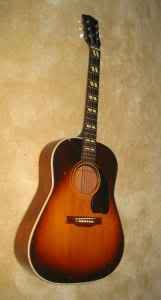
I was really upset about this one.  This is a mid forties Gibson Southern Jumbo.  The seller didn't really know what he wanted for it but invited me to come take a look.  It was in Knoxville, TN which is quite a drive from the school I was attending in Tuscaloosa (Roll Tide).  Long drives have rarely gotten in the way of a me and a guitar so I was planning to leave after my last class that day.  I called the seller back after class let out and it was sold.

This was the only picture I had of it but it was all I needed to know this was a real banner Southern Jumbo.  The split parallelogram inlays on the neck told me it was a SJ and not a J-45.  The belly down bridge combined with the lack of binding on the neck told me that this was most likely wartime (meaning is has the desirable banner on the headstock).  I should have skipped class!!


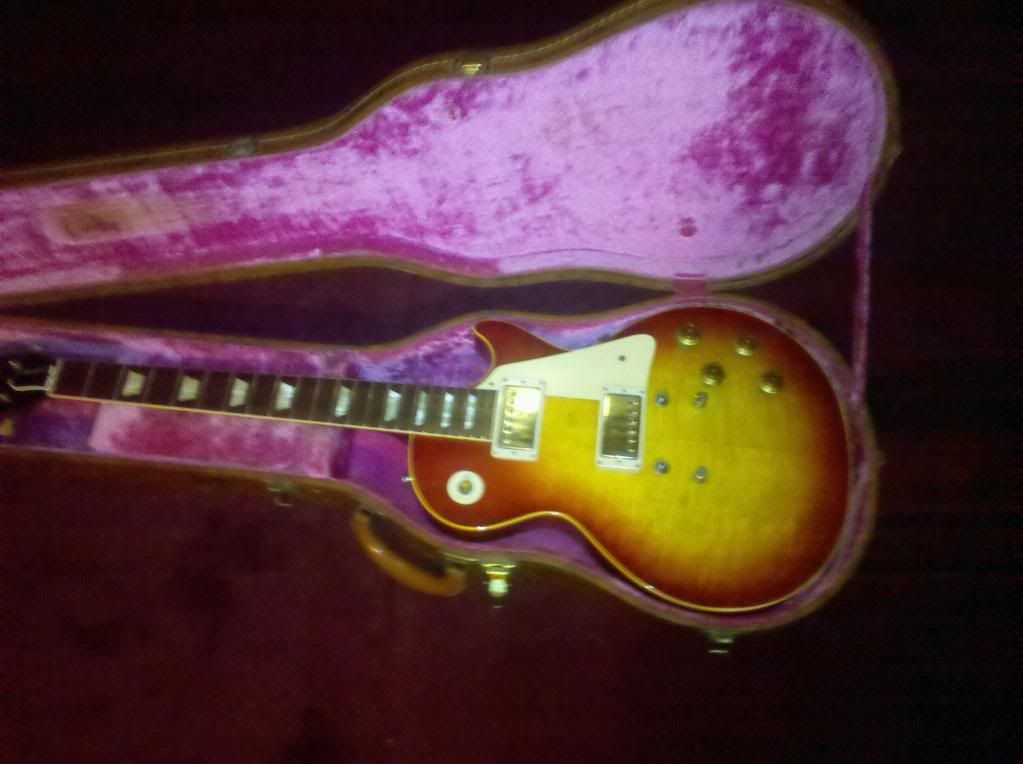
 Yes.  You are seeing this correctly.  This is a 1958 Gibson Les Paul with the original case.  This one was in northern Florida and I couldn't believe my eyes.  Most of the pictures you see of these floating around without a price tag of 200k+ are fakes.  This one was not.  I spoke with the owner and she said that she had already sold it by the time I even saw the ad.  She was working on taking the ad down and was having trouble.  Figures.


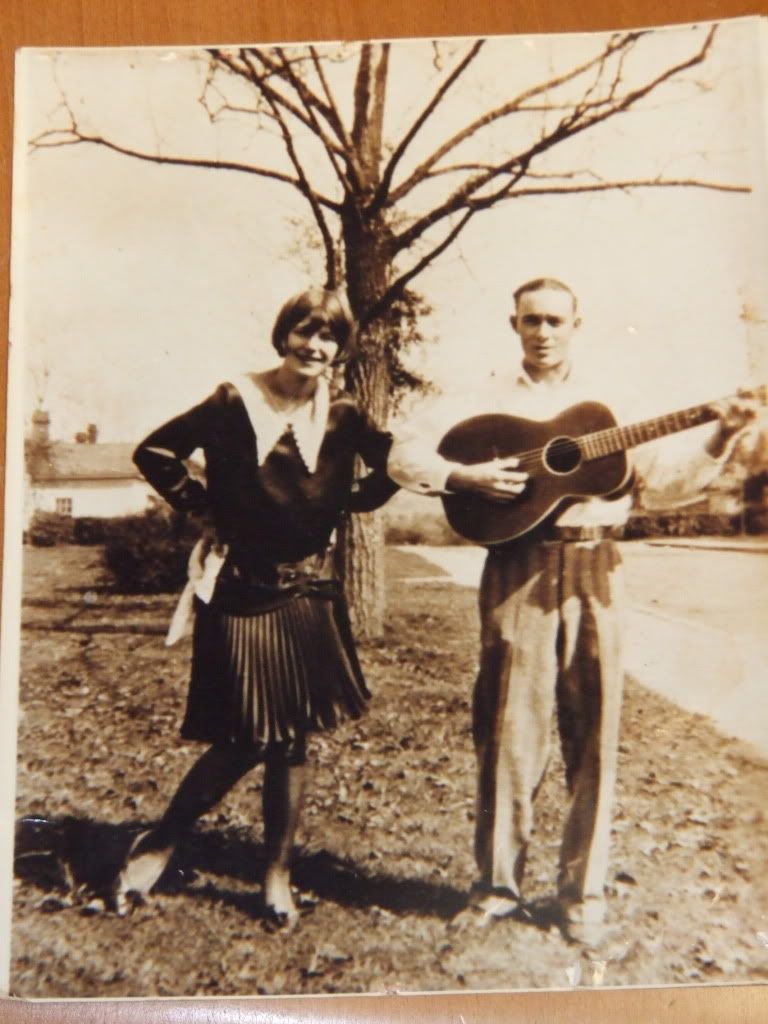
There was a musician who passed away in Cullman, AL in 2008.  His family was ready to sell off his collection of 10 instruments but they didn't know anything about any of them.  I had found a picture of this guy online that showed him holding a late 30s Gibson J-35:


I was a bit disappointed when I showed up to take a look at the collection.  It was pretty much all junk.  There was no J-35 or anything close.  There was a jacked up parts telecaster, a squire strat, a plywood parlor guitar.  That was the best of the lot and I was not really interested.  I thanked old lady that survived the man and on my way out the door she handed me this picture:


I turned to her and asked politely, "Where is this guitar?  We need to find it."  She didn't know anything about it.  Supposedly there was a blackface deluxe too but it wasn't there.  I figured that all this stuff had been picked over long ago and I was too late.  WRONG.  I was too ill-informed!  A year or two later I found this picture that I had taken:


With the help of my buddy Keith we came to the conclusion that this is that blackguard tele!!!  But how, you ask?  The neck is changed, the pickguard, hardware, all changed.   Take a look at the screws.  There are 5 old screws and one new one.  The holes are in the right place for a black guard Telecaster.  The body has been poorly refinished but I would be willing to bet that this was that telecaster- right before my eyes and I missed it!  Who knows what parts of the electronics were original.  Maybe none, maybe all.  I called the lady back and she said she had sold it a while back.  Still kicking myself.  The moment that you think you know what you are doing is when you find out that you really don't!


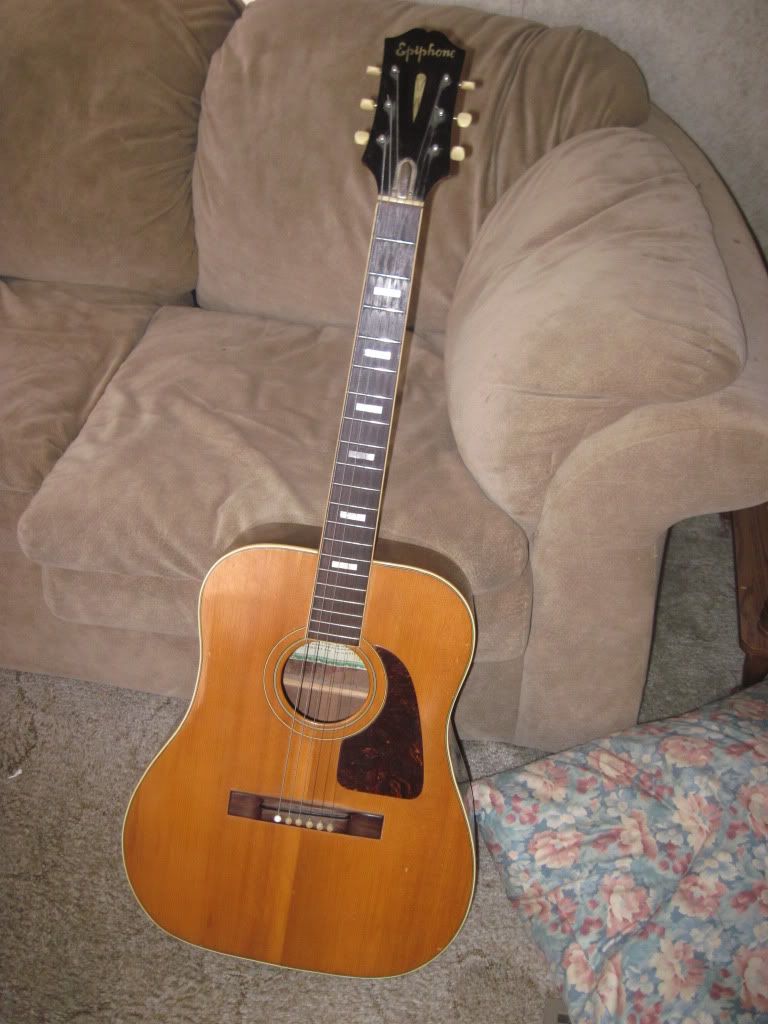
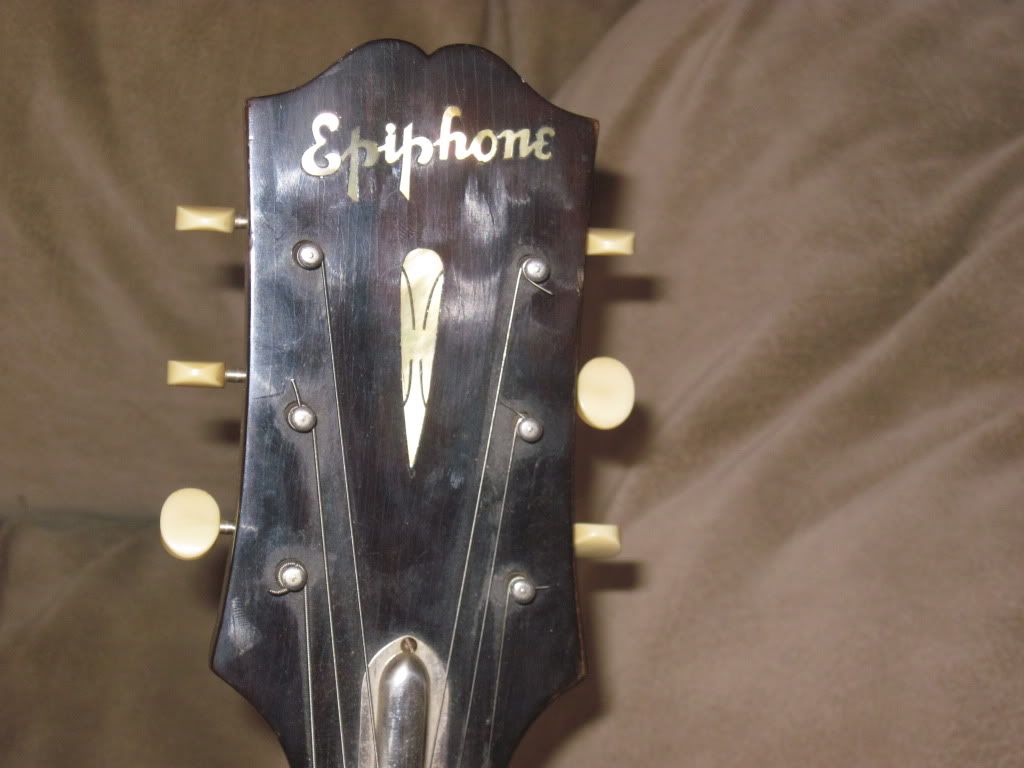
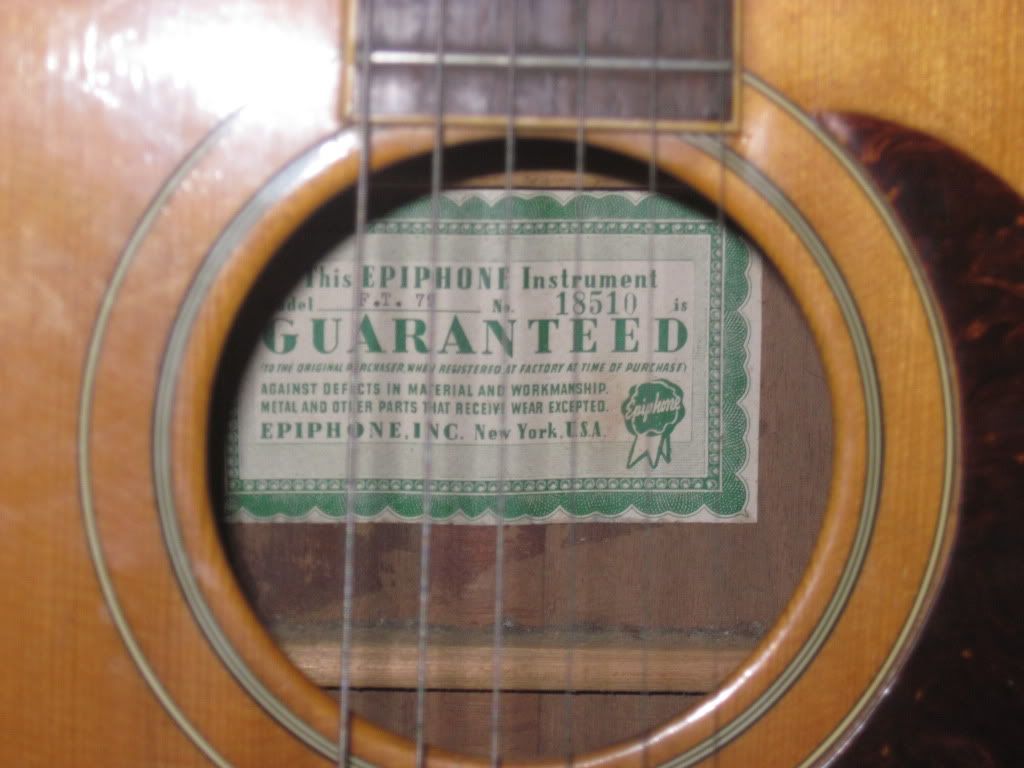
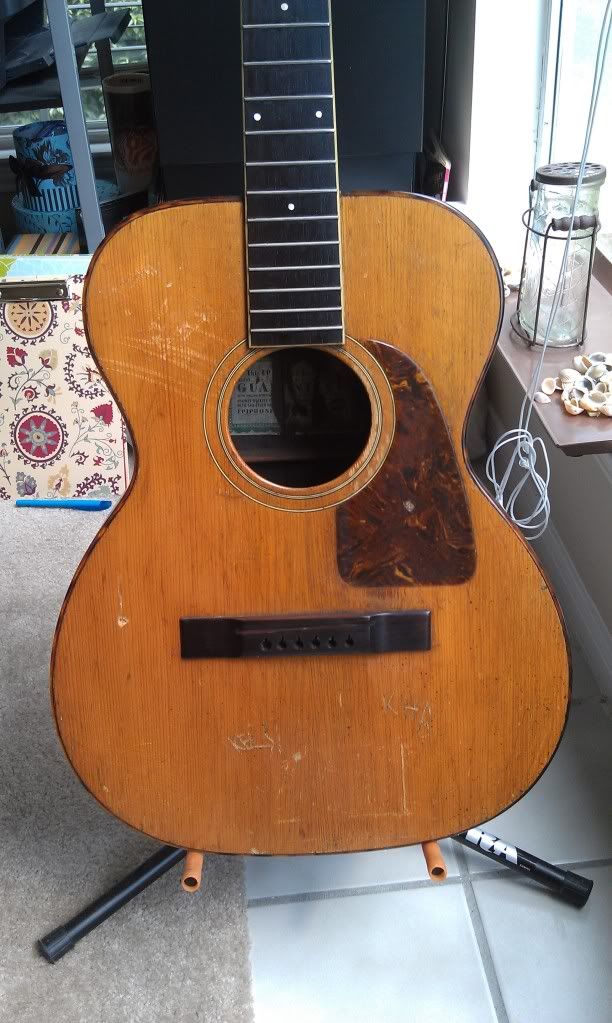
I would be impressed if you knew what this was just from the picture.  I sure didn't.  All I knew was that this was not your typical Asian made Epiphone.  This was a pre-Gibson buyout Epiphone flat top which have been aptly described as "rare as hen's teeth."  After a bit of research I found that this was the presursor to the Gibson-made Epiphone Texan.  This was a 1943 Epiphone F.T.-79.  Good luck finding another one of these at any price.


Having little knowledge of Epiphone flat-tops, I posted this picture on the Gibson guitar forum that I am a part of.   There was a guy on there that is a fellow vintage guitar guy that told me what it was and how uncommon they really are.  They are especially uncommon in this good of shape!


A buddy of mine agreed to come with me on the road trip but I decided to call the seller one more time before we left.  He had just sold it to a buyer in California.  I posted on the forum on how it had sold and the guys were giving their condolences when all of the sudden there was a new member on the forum.  It was the buyer in California!  He was a very cool guy and certainly deserved this fine, rare bird. 


Of course, there were a few scores that I didn't expect.  One of them was this little number:


This Epiphone is from roughly the same time period (WWII).  It sort of fell into my lap.  It had been through a house fire and ownership by a someone who decided to carve her name into the top.  She apparently like stickers and glue as well.  Strangely enough her name was "Kelsey".  This happens to be my wife's first name.  Strange how that works out.

Sunday, October 7, 2012

The Holy Grail of vintage guitar amplifiers: 1956 Fender Deluxe

I used to have a couple of tweed fenders and one was the Deluxe.  It was a '59.  The speaker had been changed a couple of times.  The capacitors were recent and who knows where the output transformer came from.  The tweed was ripped and covered in candle wax from a couple of different recording sessions.  And it sounded, in a word, like a small piece of rock heaven.


The amplifier pictured is clearly not my old tweed Deluxe.  This one led a completely different life than the one from the recording studio.  This one was bought used in 1964 by guy who just liked guitars.  He wasn't a great player but neither were most of the people who bought these amps new.  They were not holy grails then.  They were small, cheap amps that distorted when cranked up.  People in the 50s didn't really think that was "good."  High quality amplifiers weren't supposed to sound distorted at any volume.


So it was bought used by the second owner and played very little for most of its life.  He said he had a couple of guitars he would play through it -like his Gibson Les Paul Jr. - but mostly he played a Gretsch Chet Atkins.  Eventually, he sold those guitars but had little motivation to sell the amp because nobody cared.  As a result this amplifier sat in his closet with the cover on for years.

A friend mentioned to him recently that it was a fine amplifier and there were people out there that would pay good money for it.


Would I like to buy a near mint condition tweed deluxe?  Why yes, yes I would.  It didn't matter to me that it was 5 hours away.


When I got there I didn't even plug the thing in.  He had pawned it a few weeks before so I had to pay the pawn price and give the rest in cash.  I was happy to do so.  


The Fender Deluxe (model 5e3) was introduced in 1955 lasted until 1960.  According to the Fender Amp Field Guide this one has about 15 watts of all tube output through a 12" speaker, usually a Jensen.  A pair of 6v6gt vacuum tubes make up the power section with two 12ax7s in the preamp.  The original tubes were probably RCA but these are General Electric.  The amplifier and speaker are housed in a fingerjointed pine cabinet covered in diagonal tweed.


 Living in an apartment has its disadvantages.  One of them is not being able to crank up an amp to get that sweet, sweet tube saturation.  I took it to my buddy (who helped me find it- thanks man!) at the local music shop and we put it through its paces.  With a brand new Gibson R8 Les Paul it started distorting with the chicken head knob pointing at 3.  3!  From there to about 9 it had that beautiful overdrive these tweed fenders are known for.  9 to 12 got a little piercing with the harmonic overtones and that just wasn't what I was going for.

Then he brought out a 1960 Gibson ES-330 and let me have a go with it.  That was the combo I was looking for.  I had the 330's volume and tone pots dimed on the neck pickup with the Deluxe on about 3 and a half.  The tone.  I was just doing a little blues noodling around the 7th fret and it was everything I had hoped for.  The P-90 was thick and nuanced.  The Deluxe's pair of GE 6v6s were lightly distorting and absolutely growled when I dug in deep.  It was very responsive. The lightest touch produced sparkly cleans that darkened substantially with a little right hand heat.  I was sold.


After the tone expedition we decided do do a little research into the originality of this amp.  The capacitors, transformers, potentiometers and switches all seemed original and in good shape.  The GE tubes were probably replacements but I am still not convinced on the speaker.  It should be a Jensen but there were some exceptions.  Oxford and Rola seem to come to mind.  In all likelihood the original Jensen was changed by the first owner.  The second owner said he did not change the speaker and I believe him.  The music he was playing did not require loud or distorted tone so it is unlikely he pushed the speaker to its breaking point.  If you have any more information or theories then please feel free to comment!


Fender amps are easily dated by their tube charts.  They usually have a stamp with two letters for a year and a month.  This one bears the letters FJ meaning 1956 and October.


They also usually have a little piece of masking tape bearing the initials of the person who wired the amplifier.  This one is a bit obscured by time but the name on the tape is Lily.  The other popular names that show up are: Lupe (most popular), Lily, Eileen, Margaret, Rachel, Maybell, Lydia and Julia.


Hope you enjoyed a look at this amp.  Maybe I can get a real guitar player to help me out with a video of it.


My buddy Chris at Bailey Brothers Music in Birmingham was kind enough to shred on this amp after I got it all cleaned up.  He also let me take a few videos of it.  Check them out:


Thanks Chris!  Nice playing!

Monday, August 20, 2012

Field Trip: 1957 Fender Vibrolux

A friend of mine called me the other day and said that he had just traded his old drum set for this 1957 Fender Vibrolux:


Needless to say, I was very excited.  Back in school I bought a small collection of vintage Fenders including a 1960 Champ, 1959 Princeton, 1960 Deluxe and a 1964 Vibro Champ.  Pete would come over and we would blues out with me on his Strat (and the Deluxe!) and him on the harmonica with the Champ.  TONE gentlemen, tone.

Until one time I was holding the strat and he had the harp mic in his hand and he tried to show me where on the fretboard I should play.  As he touched the strings and froze I instantly remembered how both of these awesome old tweed amps had the original 2 prong power chord.  "Dude, are you alright?' I said not sure if he was confused or shocked (literally). One second later he jumped back out of his frozen state and reminded himself never to do that again.  Please change the 2 prongs to 3.  Vintage isn't cool if you are dead.
But I did remember how wonderful that deluxe sounded after the tubes warmed up.  Here is a shot of my old tweed Deluxe (gone now along with the others):

That is candle wax from an old recording gig it played


Full shot of Pete's Vibrolux:


 Tweed doesn't always wear very well after this long.  I actually really dig the distressed look of an old amp.  The speaker has been replaced but it still sounded so sweet with my '64 Fender Duo-sonic.  We played a little jam of Hendrix's "The Wind Cries Mary" with him playing lead on the DS and me playing rhythm on his 1951 Gibson J-50.  Loads of tone.


The Vibrolux's were rated at 10 watts and had a 12" Jensen speaker.  They had 3 instrument inputs and a Depth, Speed, Tone and Volume knob.  They have a variable bias tremolo that really sounds sweet.  This particular unit had a GE 5y3 rectifier tube, a Sylvania 6v6 and an Emerson 6v6 power tubes and unknown 12Ax7 preamp tubes.


Luckily, the original 2 prong chord had been traded for a 3 prong recently.  You can see from this picture that the tweed Fender cabinets were finger jointed pine boxes.  This is a really cool way to join two pieces of wood and allowed for great transfer of tonal energy throughout the entire box.  Plus, it looks awesome.  Fortunately this one shows off it's finger joints!


Here is a video of Chris playing through a brand new Echoplex to the Vibrolux and a new Victoria (tweed bassman).


Tuesday, August 7, 2012

My Vintage Guitar and Gear Wishlist.... and why I think these things are cool

There are always weird guitars and gear that I see and hope to run into one day.  Recently it has been a Harmony made Silvertone and a brand new amp from Fender.  More on that one later.

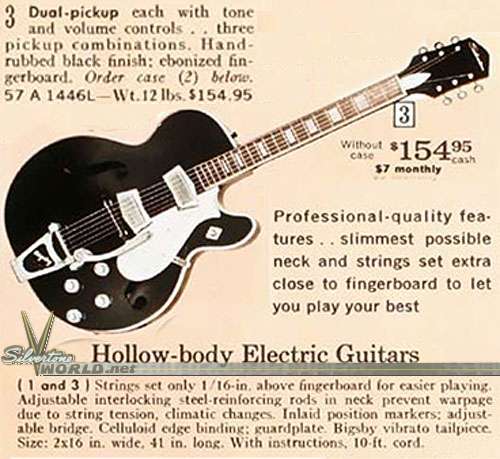
The Silvertone 1446l has been popping up on my radar just about everywhere.  These things are American made by Harmony in Chicago from 1962 until 1967.  They featured a Bigsby Vibrato, a hollow body of laminated maple (even though the ads said Spruce top and back!) and the very illusive Seth Lover designed, stagger-poled mini-humbuckers.  I have never held one of these in my hands but supposedly these pickups screamed with higher output and thick silky humbucker tone.  This one is often refferred to as the Chris Isaak model but I believe that Dan Aurbach of the Black Keys is a fan as well.  Do you have one for sale?? Contact me!


And now, for something completely different: The Fender Pawn Shop Series' Greta.  These things are a bit "gimicky" but they are just so damn cute.  It is a two watt (tube), table top radio style guitar (and iPod) amplifier.  It features one 12ax7 preamp tube and one 12 at7 power tube and breaks up faster than your "high school sweetheart" friends.  The 4"speaker has a bit of a hard time keeping up with the output but plugged in to a cabinet this thing is an apartment ready blues machine.


Notice the "VU" meter?  It is a total gimmick and I love it.  VU stands for "Volume Unit" with the green section indicating clean tones and the red indicating distorted.  The meter is backlit with a small blue LED that is really just fun to look at.  The knob on the left is gain and the one on the right is tone.  

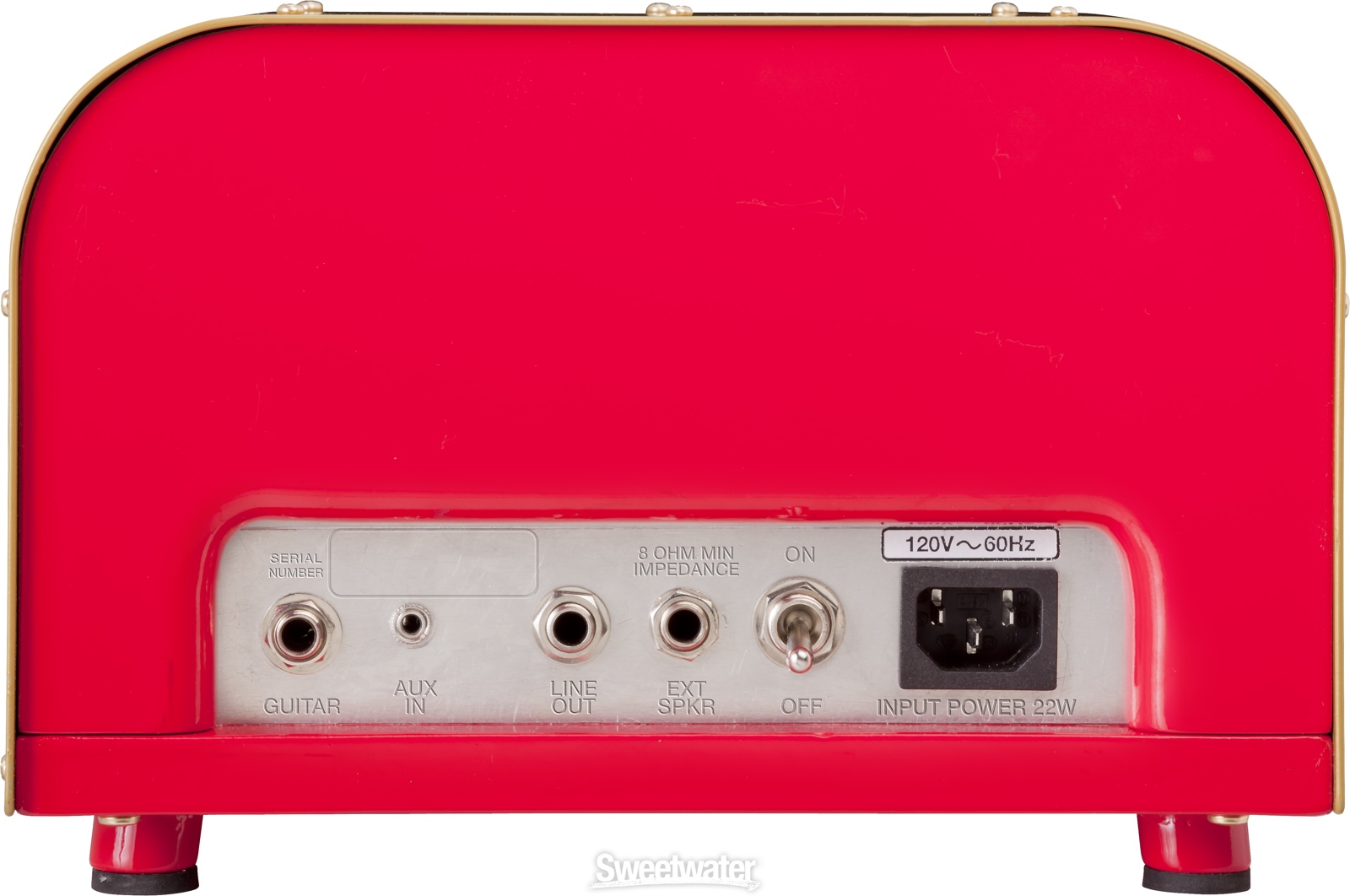
The coolest part about this little amp is what is on the back:

From left to right: Guitar, Aux In, Line Out, 8 ohm Ext. out, Switch, Power Input
Fender made this amp very versatile with all the ins and outs.  With the 4" speaker there isn't much headroom before the speaker farts out.  Which is why they added the 8 ohm extension out.  This thing sounds really good through a 4 12" cabinet.  It has a little more headroom but still has a nice, thick tube crunch.   If you are looking for a sparkly clean tone then you should probably look somewhere else.

But what if you have a larger amplifier that you like but can't play at the volume you want at home?  Enter the Greta, once again.  It has a Line Out that you could run a 1/4" cable directly into that amp's input.  Just use it like a distortion pedal.

But what if you are a trendy hipster with a turntable and feel like your warm, analog signal path is being ruined by your solid state stereo?  Enter the Fender Greta's Auxiliary 1/8" input.  Plug your turntable into this little guy for analog tone that lets your recent Grizzly Bear or Bon Iver vinyl sound like it should, I guess.  Or just plug in your iPod (digital music through an analog amplifier?).  I actually have not experimented with this feature of the Greta although I would love to.  My wife and I listen to a wifi radio (Logitec Squeezebox) every morning and I would be very interested to hear how it sounds through the Greta.  Do you play your iPod through your Greta?  Comment and let me know what you think about it.