Showing posts with label 1950s. Show all posts

Sunday, September 22, 2013

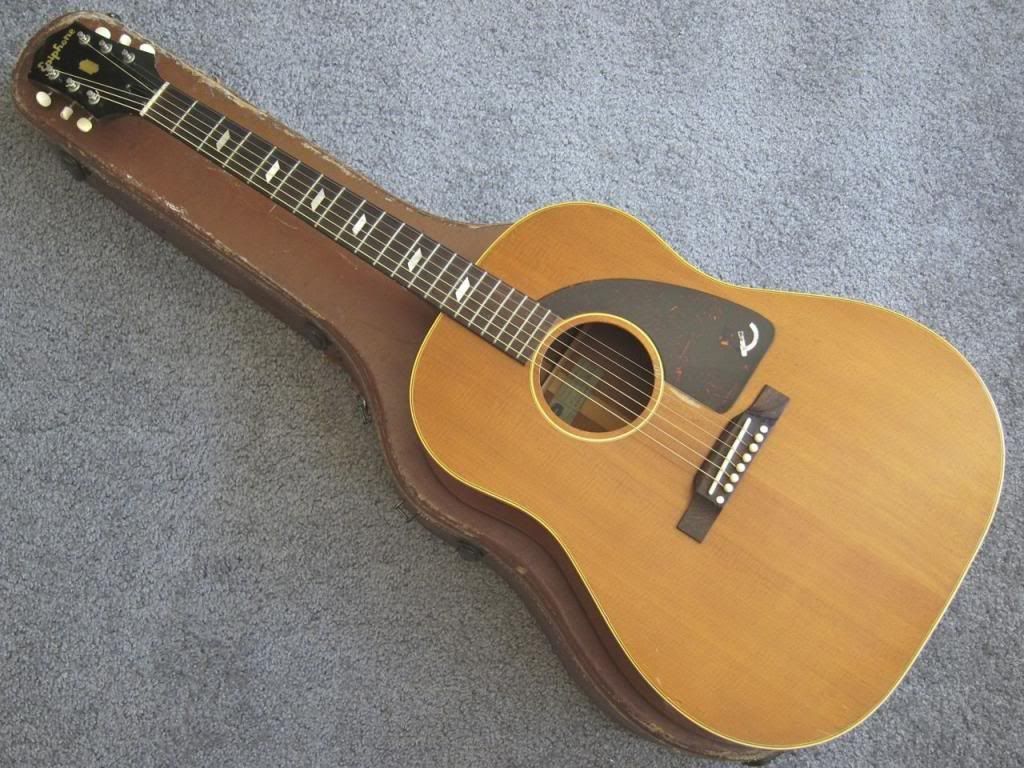
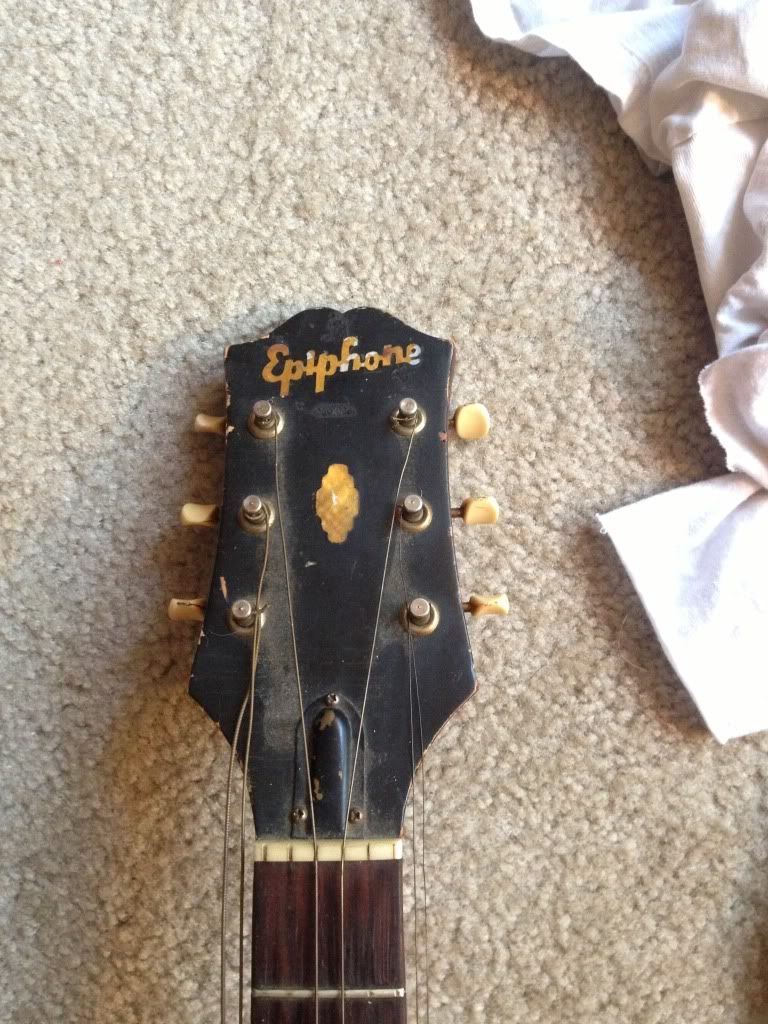
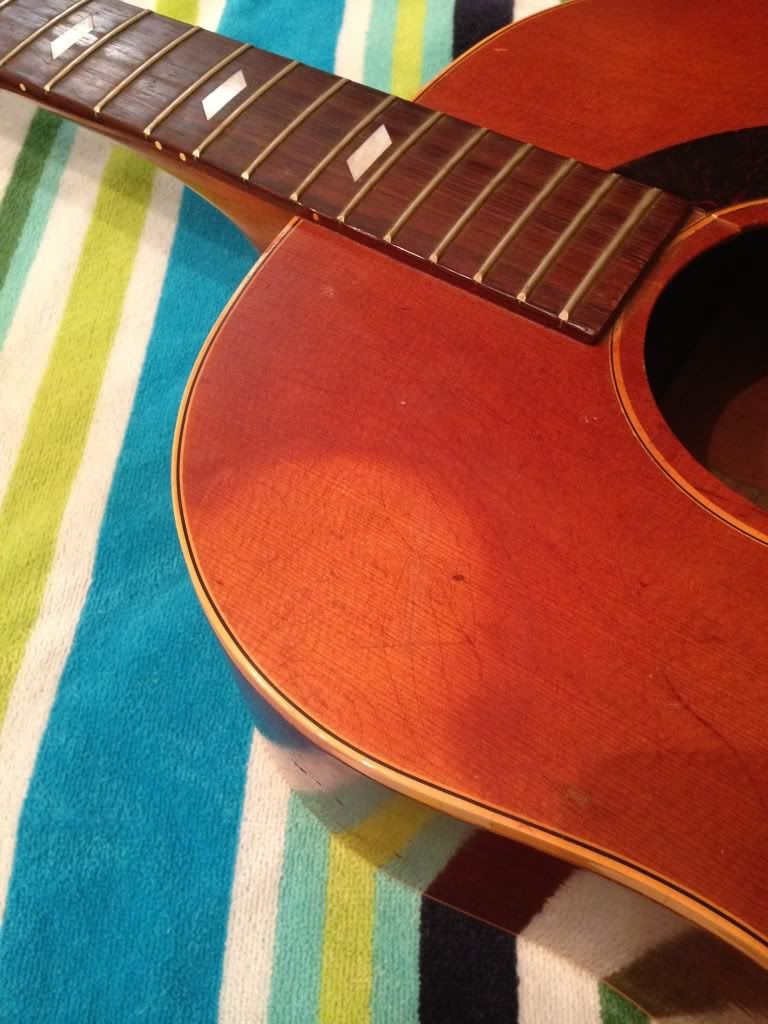
The first appearance of the Epiphone Texan - c.1958

These guitars baffled me for some time with their odd features.  I tried to get my hands on one but I just couldn't find an early example.  This 1958 Texan ended up coming to me.


What makes these so special

is the fact that they are an enduring example of Epiphone and Gibson history.  The body and the neck on the early Texans were made in 2 different factories.  When Epiphone sold to Gibson they shipped all the leftover parts to Philadelphia to Kalamazoo.  Gibson began building guitars out of them using everything they could.  This guitar uses two parts from Philadelphia and the rest from Kalamazoo.


The first part from Philadelphia is the mostly finished neck.  The back of the neck shows off the 5 piece laminate construction and subtle V shape found on 1950s era Epiphones.  It appears that Epiphone used Mahogany-Maple-Mahogany for the main neck structure and glued Walnut wings on the sides of the headstock.  The thrust rod cover is direct from Epiphone as well housing the hex nut on the end of the rod.  These covers must have run out early because many of the Philadelphia necked texans have a plastic cover that was most likely made by Gibson.  It's rare to find these with the shaped brass cover.


The second part that Gibson decided to re-use from Philadelphia is the laminate, unkerfed lining.  I had heard stories of solid lined Texans but I had never seen it up close.  My 1954 Epiphone FT-210 Deluxe Cutaway has the same lining so it must have been in the parts shipment from Epiphone.  


The tone

One major tonal difference in these Texans and a similar year J-45/50 is the fact that these necks are designed for a longer scale length.  A longer scale length means that the strings have to be tighter in order to sound the same note.  A higher string tension generally results in 2 things: a slightly stiffer feel and a bit more volume.  

If you haven't played many late 50s J Gibsons then this difference will be unnoticeable.  Even if you have played a lot of them the feel and tone is very familiar.  The biggest difference in player experience is the smaller nut width and subtle V shaped neck.  I found the neck to be very comfortable but a bit smaller than what I'm used too.

Is a buyout era Epiphone Texan for you?

If you interest in vintage guitars find its roots in history, design and the search for great tone then they definitely deserve a hard look.  I joke with friends about how having an American made Epiphone is the quickest test for people who like guitars.  The majority of players will see the name one the headstock and associate it with the current day market.  That guy will keep on walking and buy him a Taylor.  But every once in a while this guitar will stop someone in their tracks and make him question whether it was made in New York, Philadelphia or Kalamazoo.

Do you have one of these that you would like to sell?  I'm looking for another.  Please email me about what you have for sale.

Wednesday, May 8, 2013

"Buyout" Period Epiphone Texans: Parts Guitars?

By the dawn of the 1950s, the Epiphone company was struggling with problems in both the accounting and labor departments.  The company's product line hadn't kept up with the changing trends in guitars such as the new solid body electric (Gibson's Les Paul model?).  It had moved the production facilities from New York to Philadelphia in an attempt to avoid a problem with the labor union.  By 1957, the company's doom seemed imminent which forced its sale to their biggest competitor, Gibson, for the sum total of only $20,000.


American made Epiphone guitars (both during and before the Gibson buyout) are fantastic instruments.  Their relative obscurity and high standard of quality is a recipe for a very inspiring guitar.  I recently came across an immediate post-buyout Texan that has me intrigued (1959 Epiphone Texan with strange features).  The description states:

"Gibson FON on the neck block indicating 1952 manufacture, starts with a "Z"; solid, un-kerfed linings (no one has ever seen this on any modern Gibson instrument); the word GUITAR rubber-stamped on the inside of the back, between the neck block and the first back brace; black paint on the heel underneath the clear coat, which has been seen many times on various Gibsons in the 1960's."

 1952?

The body is easily dated using Gibson's backwards letter prefix used from 1952-1961.  They started with Z in '52 and ended with Q in '61.  These letters were stamped on the interior neck block and were proceeded by a batch number (usually 4 digits) then a unique rack number (the Xth number in that rack).  This guitar received a Z indicating that it was made in 1952.

Easy, right?  Not quite.  The description also states that this guitar has solid lining (as opposed to kerfed).  Lining is what gives the body's joints (top to rims and rims to back) a solid gluing surface.  Usually this lining is kerfed, meaning that it has small cuts vertically to make it bend without needed to be soaked in hot water and bent over a hot pipe.

Kerfed Lining

Solid Lining

Gibson phased out solid lining in favor of the kerfed style from 1933-1934.  I have never seen any flat-top Gibson guitar that used solid lining after 1934.  I would venture to say that Gibson did not build guitars using this kind of lining after 1934.  This is my opinion based on my experience so feel free to prove me wrong.  Edit:  I just acquired one of these guitars.  The lining is made of laminated Poplar.  The only other place I have seen this is on my 1954 Epiphone FT-210 Deluxe Cutaway.  I'm assuming Gibson got leftover strips of lining from Epiphone and used it?  Not sure.

(Edit)  At least Gibson phased out the use of solid lining made of Mahogany in 1934.  After acquiring a buyout period Texan I determined that this "solid lining" wasn't really solid.  In fact, it is made of laminated strips of what looks like Poplar.  The only other place I have seen this is on my 1954 Epiphone FT-210 Deluxe Cutaway.  Perhaps Gibson also acquired strips of unused lining from Epiphone as well as necks?

Gibson "J" body surplus

In the early 50s Gibson was selling some of their jumbo bodies to National.  National would manufacture a neck and bolt it on to a Gibson body calling it the National 1155.  These are great guitars for the vintage player on a budget but I am told that the necks are a bit difficult to get used to.  You'll have to decide that for yourself.


Since National ordered a bunch of J bodies from Gibson, they had more bodies than necks.  When a bunch of Epiphone necks showed up at Gibson's doorstep in 1957, the answer was simple.  They went downstairs to the parts basement and grabbed a bunch of J sized bodies.  That is how I would explain this guitar having a Z (1952) factory order number.

(Edit) .....but I'd be wrong.  After acquiring one of these, the tops were definitely made post 1955 judging by the bracing.  My next theory would be that Gibson needed finished bodies to sell to National.  Since National was bolting on the necks, Gibson needed bodies with uncut neck blocks (instead of cut for a dovetail joint).

When the Epiphone necks showed up in 1958 they were already cut for a dovetail joint.  Since the dovetail extension on the neck and the neck block were cut by two different manufacturers they differed to the point that they wouldn't fit right.  Gibson would need to use a body with an uncut neck block and cut it to fit the Epiphone neck.


So you have one of these short headstock Texans?  Send me some shots of yours.  Here is @guitaristo's (Instagram) 1958 Epiphone Texan that has recently been sold.  The serial on the blue label was an A-XXX number but he can't remember what was on the neck block.  I wonder if it was an earlier FON?


Why do these features even matter?

Although these Texans look like weird J-45s they are certainly not.  The main difference in a standard Texan and J-45 is the scale length.  Epiphone was using a 25.5" scale length so the necks were manufactured to this spec.  Gibson's traditional scale length and that of the J-45 is 24.75".  This alone makes for a tone that is probably louder and more piano-like than a J-45.  It also doesn't bend strings as well and may wear out your fingers a bit quicker.

This '58 Texan has more than just the scale length to set it apart from a J-45.  The body was probably manufactured in '52 which means that it differs from a '57 by the bracing.  The pre-'55 J bodies were made with scalloped braces while the post-'55s had straight braces.
(Edit):  Wrong again, TVG.  While the FON prefix was Y, the tops were definitely made in the late 50s.  The bracing is short and straight (unscalloped).

These buyout era features make for an interesting guitar.  Mine needs some braces reglued before it is playable again.  It was covered in 50 years of sweat and tar until I hit it with some Virtuoso cleaner.  Here are some shots of the clean up.


TVG


Friday, January 11, 2013

Vintage Guitar Artist Spotlight: Brad Barr and his '51 Gibson J-45

I love watching youtube videos and finding within them little vintage gems that somehow don't get mentioned in the comments.  This video was recorded by KEXP in Seattle at the 2012 Pickathon:


That is Brad Barr of the Barr Brothers playing a beautiful 1951 Gibson J-45.  I think that this is where the J-45 really shines.  The mid-range rumble is just about perfect for the singer-songwriter types.  


The fact that the guitar is a beautiful work of art and has played 62 years of wonderful music is what begs the songwriter to do what he or she does best.  I get that feeling when I play these old Gibsons.  I want to play that guitar just because of what is, how it looks and how it sounds.  I am a better guitar player because the instrument begs me to play it

From a GuitarInternational.com interview with Brad:
"I have a J-45 from 1951 that is the sweetest sounding acoustic.  It has a great midrange and a real growl...."
Maybe you have been there before when pen, paper, a bottle of whisky and 3 and a half hours produce nothing but balled up paper in a trash can.  You decide that your done writing tonight because its 1:30 in the morning you aren't really feeling it anyway.  You start playing your favorite chord progressions and licks just because that guitar feels and sounds so good.  After a minute or two you modify that chord progression a mumble a melody without any words.  The next thing you know you are belting out a strong chorus from your couch when you notice the sun peeking through your window.  You've just spent the whole night writing that song but you didn't realize it because it just had to come out.

I don't know if this has been Brad's experience but there is something about a big rumbly Gibson jumbo.  Here are some shots of my current J-45 lineup:


Oops, that J-50 just sneaked in there.  In order they are '46, '43, '54 and '55.  They are all so sweet and have their own special nuances.  They are certainly guitars worthy of staying up all night just to spend time with them.

TVG


Friday, December 28, 2012

On buying old, broken guitars before you can hear them

Most of the guitars that I buy are finds- as in they have been in a closet or under the bed for 30 years.  That means that they usually need a fair amount of repair like loose braces, neck sets, lifting bridges, etc.  When they need these kind of structural repairs I can't play them before buying.  I can't always hear how they will sound after being fixed up before I buy them.  It can be a bit of a gamble.  Here are a couple of those gambles.


This was probably the biggest gamble of all.  This is a 1943 Gibson J-45.  This has the fabled "banner" gracing the headstock that was only present during the war years.  I bought it from the grandson of the original owner.  The back braces, tone bars and finger braces were all loose.  The owner could not be convinced of this fact for some reason.  He had strings on it at full tension which caused the action to be very high.  I bought it anyway because I wanted a banner.

This was a GREAT bet.  I figured it would need a neck set but after the braces were glued tight the neck set was perfect.  It has almost factory saddle height.  The tone is warm, dry and very responsive.  You can feel the pluck of each string deep in your chest.  Suffice it to say they were right about the banners.


This 1955 Gibson J-50 was a recent gamble.  It was listed as a '54  and was about an hour and a half from Birmingham.  I could tell from the pictures that while the tuners were there the buttons were not.  I just happened to have bought an old Kay with period Klusons for next to nothing the week before!  When I got the guitar in my hands I could tell that the bridge had been shaved meaning that it probably needed a neck set.  I bought it anyway.

This is a very special guitar and probably the best gamble of all.  I took it straight to my local shop where my friend Keith works.  We put the extra set of Klusons on and strung it up.  As he was winding the strings I could hear that familiar hollow thump typical of the round shoulder Gibsons.  At full tension we immediately knew that this was not just an average 50s Gibson.  It was loud, nuanced, responsive and most of all LOUD.  I'm talking bluegrass loud.  We couldn't hear each other talking over the rumbling E chord.  Then we took it into the acoustic room to compare it to some new guitars.  We soon realized that this was guitar of myth and that it could never leave our circle of pickers.


This is a 60s Silvertone (Harmony Sovereign), I can't remember the Silvertone number designation.  I bought it from a different local shop needing a neck set.  When they got it in the called me because they knew I love the American made solid wood guitars.  They just said it was a Silvertone.  When I walked in I immediately recognized the distinctive bean shape and pinless bridge as a rebranded Sovereign.  I was ecstatic.  They thought I was crazy for buying a hard case for it.

The neck set was easy because the dovetail had already shifted in the joint.  I strung it up and started strummed some cowboy chords and fell head first in love with Sovereigns.  The J-45s sat in their cases for a few days while I became acquainted with it.  It had the rumble of a J-45 but sounded more bluesy- no, boxy.  This was probably a result of the ladder bracing.  Sometimes I just want to strum my favorite chord progression and belt out the lyrics.  This guitar was just about perfect for that.  It had the magic and can be had for less than $500.  Don't be fooled by the price, this is a professional instrument.  I sold it to a big time session player in Nashville.  It is a safe bet to say that you have heard him play.


It is a special feeling to strum an old guitar for the first time.  It is even more exhilarating when you have a bunch of time and money invested in it!  Maybe I have just gotten lucky but I have never had a bust- yet.   If you find one of these for a good deal then don't be afraid.  Take the plunge.

TVG


Wednesday, October 17, 2012

From the Bailey Brothers' VAULT: 1960 Gibson ES-355

You have heard of it happening.  Most guitar shops will have somewhere that they keep the "good stuff."  You are standing in your favorite local guitar shop.  You overhear another customer say something like "have you gotten in anything good lately?" while he is standing next to Custom Shop Les Pauls, Gretsch White Falcons or CS black guard Teles and what not.  As if those were not good.


This customer is talking about the stuff in the back room, upstairs, or maybe even right behind the counter and out of sight of the average dude walking in to for the sole reason of playing "Stairway To Heaven" for everyone to hear.


You might be asking yourself "what do they have back there?"  This is one of the things they might have.  But probably not.


1960 Gibson ES-355 with the original brown Lifton case.


The ES-355 was officially introduced in 1959 but supposedly a couple were shipped in '58.  It is constructed of a laminated Maple body with a solid block down the center and a neck of their standard, Mahogany.  It also features 2 humbucking pickups- just like a 335.  Where it differs from the 35 is in the fretboard (Ebony instead of Rosewood) and all that sexy bling, binding and gold hardware.  Oh, and the factory Grover tuners (the good ones) and Bisgby tailpiece.


This example made it out of the factory with some cool features.  The serial number says that it was manufactured in 1960 so it must have been early in 1960 because it has the longer pickguard as well as 19 frets to the body (instead of 20).  In 1960 they shortened the pickguard so that it would not go past the bridge pickup.


The best part of these 355s is that they featured gold plated hardware.  PAF pickups were made in nickel and gold finishes.  Gibson used nickel hardware on most of their guitars and saved the gold hardware for the really fancy ones.  As a result, the gold covered PAFs lasted well into the early 60s.  This one features PAFs.  They sound damn good too.


Most of the 355s came with a feature that Gibson called "Varitone."  This was a switchable notch filter that cut certain frequencies using a range of different capacitors.  Many players/collectors think that Varitone "kills tone" and therefore it makes a vintage 355 less valuable.  I haven't messed around with a Varitone switch enough to form my own opinion but I do like the simplicity of not having it.  This guitar was spared of that switch.


Here is a shot of a real M-69 pickup ring.  You may be wondering to yourself why this little piece of plastic matters at all.  They are commonly faked and sold for a good bit of money.  If you buy one of those $200k+ '59 Les Pauls you are probably going to want to have all original parts.  But, these pickup rings were prone to crack and break.  Many were replaced throughout the years.  Now you have a market for  little pieces of plastic that apparently go for $500 or so.  Go figure.


This guitar had a little surprise for us when we decided to take out the neck pickup to check out the PAF.  We removed the pickuard in order to get a good look at the PAF (the bridge pickup's lead was too short!).  We had been discussing what kind of person would have bought this instrument new in 1960.  I was thinking a big band guy or a jazz guitarist.  Probably not the standard country western kind of thing that was popular at the time.


When we set the pickguard aside we noticed a name stamped on the underside of the pickguard.  Max Williamson.  I couldn't find anything about him online but maybe you have some information about him?  Here's to you, Max, and your good taste in fine instruments.


This guitar is available from Bailey Brothers Music Company in Birmingham, AL.  Thanks to Clay and Keith for letting me snap a couple of quick pictures of it.

TVG

Tuesday, October 16, 2012

Just a good, southern late 50s Gibson J-45.. and a quick video of my 1964 Gibson B-25

Carl posted about this guitar in the comments section of the post of my 1953 J-45:


I love getting these emails.  You never know what you are going to come across.  This one has 20 frets to the body, larger pickguard and non-adjustable bridge.  That would put it between 1955 and 1961 (about).  I don't have a picture of the FON so I can't nail down the year.  I have an up close picture of the fretboard and it looks to be flat-sawn Rosewood instead of quarter-sawn.  My 1960 Gibson Melody Maker has that same kind of ugly flat sawn Rosewood.  Could be 1960?

This was Carl's dad's guitar that was bought second hand from an old lady who had listed in the local paper.  I won't tell you how much he paid but it was less than 3 digits.  Good deal!!  Carl's dad never learned to play so it hasn't seen much playing time.  Hold on to that one, Carl!!


On a separate note, here is a video I took today of a Gibson I am currently selling on eBay:


Subscribe to my YouTube channel if you want to see some more videos of vintage guitars!  I'll be uploading some videos of my J-45s and other guit-fiddles soon (hopefully).


This is a 1964 Gibson B-25.  Despite the total refinish, it really is a nice guitar.  I haven't played many Gibsons with ADJ bridges and I had always been told how bad they sound.  Maybe my expectations were low but I really like the way it sounds.  The high "e" string really rings true and loud.  It still has that little percussive "thump" in the body when you strike a string.

I am also very fond of this tune called "Murder In the City" by the Avett Brothers.  I did you the favor of not singing it in the video.  You're welcome.


Monday, August 27, 2012

50s Kay Kraftsman Jumbo.... The poor man's J-200

I saw an old amp on Craigslist in Tuscaloosa the other day.  It was a Silvertone 1472 sporting about 10 watts or so and a 12" speaker.  I was heading to Tuscaloosa on business that day so I figured I would inquire about it.  Unfortunately I was about 10 minutes too late.

The seller was very nice and asked what else I was interested in.  I told him I like anything old and made in America.  He said he had an old Kay flat top that had a body made by Gibson.  I thought to myself, "I've heard that before."


The body was not made by Gibson but that didn't matter to me.  This is a mid 1950s Kay (Harmony) Jumbo (actual model? I dunno.  Maybe just Kraftsman).  It was made in Chicago and features a solid Spruce top, solid one piece flame Maple back and veneer sides.  It has 17" wide hips (a regular dreadnought is 16") and has ladder bracing.  It is original save for the Guild bridge added sometime long ago.  It even came with the original Kluson tuners!


I was drawn to this guitar for three reasons: the size, appointments and the FLAME MAPLE BACK!  This is an absolutely beautiful slab of maple.  They didn't even cut it in half and book match it.  It is just one solid piece of sexy Maple.


She came to me in pretty good shape except that the neck was falling out and there was no nut or saddle.  I was very excited to have another neck reset project.  My last one didn't go so well but I learned a lot from it.  You can read all you want about it but there is not substitute for just doing it.  I highly suggest it if you are so inclined and have a suitable subject (ie not Gibson).


This is a dovetail joint.  It requires skilled craftsmanship to make and fit the neck to the guitar at just the right angle.  It takes a lot more time and human attention than a bolt on neck.  Dovetail joints are not easily made by machines.  They are a sign of old world craftsmanship.  Do you own a Taylor?  Your guitar probably does not have one of these.


I was really excited to see no gaps when I was done!  These are crappy cell phone shots.  I forgot to take real pictures.  I didn't want any good evidence in case it went bad.


The wife was kind enough to let me turn the apartment into a repair shop.  It was a mess and still kind of is.  This is a shot of me cutting the me bone nut.  It was my first full nut made from scratch.  I was happy with the result since it was my first try.  I will definitely do some things differently next time.

This is an interesting guitar because it has a 26" scale length.  That is the distance from the saddle (the white piece on the bridge) to the nut (the white piece at the top of the neck).  The standard scale length for a Gibson is 24 3/4" and the standard Martin scale is 25 1/2".  This is significant in both the way it plays and sounds.  A longer scale means that the strings must be tighter in order to sound the note.  This  usually makes for a louder and more difficult to play instrument (on average).  The tighter the string is the more difficult it is to push the string down to the fret.  Needless to say, this thing is a hoss to play and sounds great!


Another interesting feature (or lack thereof) is the absence of a truss rod.  Maybe it was just an attempt to save money.  They accounted for this by making the neck a monster.  It is by far the biggest neck I have ever seen.  It really gives it that 40s and 50s feel.  The neck is straight as an arrow so I guess they called Time's bluff.
I really like the peghead overlay on this one.  They used a celluloid overlay and carved and painted the detail and logo with white and gold paint.  I was talking with a friend about this guitar and he made a good point about how the peghead is very underused and plain on most guitars.  I agreed and thought that this was one of the most beautiful headstocks I have ever seen.  

Enough talk.  Let's pick.


Monday, August 20, 2012

Field Trip: 1957 Fender Vibrolux

A friend of mine called me the other day and said that he had just traded his old drum set for this 1957 Fender Vibrolux:


Needless to say, I was very excited.  Back in school I bought a small collection of vintage Fenders including a 1960 Champ, 1959 Princeton, 1960 Deluxe and a 1964 Vibro Champ.  Pete would come over and we would blues out with me on his Strat (and the Deluxe!) and him on the harmonica with the Champ.  TONE gentlemen, tone.

Until one time I was holding the strat and he had the harp mic in his hand and he tried to show me where on the fretboard I should play.  As he touched the strings and froze I instantly remembered how both of these awesome old tweed amps had the original 2 prong power chord.  "Dude, are you alright?' I said not sure if he was confused or shocked (literally). One second later he jumped back out of his frozen state and reminded himself never to do that again.  Please change the 2 prongs to 3.  Vintage isn't cool if you are dead.
But I did remember how wonderful that deluxe sounded after the tubes warmed up.  Here is a shot of my old tweed Deluxe (gone now along with the others):

That is candle wax from an old recording gig it played


Full shot of Pete's Vibrolux:


 Tweed doesn't always wear very well after this long.  I actually really dig the distressed look of an old amp.  The speaker has been replaced but it still sounded so sweet with my '64 Fender Duo-sonic.  We played a little jam of Hendrix's "The Wind Cries Mary" with him playing lead on the DS and me playing rhythm on his 1951 Gibson J-50.  Loads of tone.


The Vibrolux's were rated at 10 watts and had a 12" Jensen speaker.  They had 3 instrument inputs and a Depth, Speed, Tone and Volume knob.  They have a variable bias tremolo that really sounds sweet.  This particular unit had a GE 5y3 rectifier tube, a Sylvania 6v6 and an Emerson 6v6 power tubes and unknown 12Ax7 preamp tubes.


Luckily, the original 2 prong chord had been traded for a 3 prong recently.  You can see from this picture that the tweed Fender cabinets were finger jointed pine boxes.  This is a really cool way to join two pieces of wood and allowed for great transfer of tonal energy throughout the entire box.  Plus, it looks awesome.  Fortunately this one shows off it's finger joints!


Here is a video of Chris playing through a brand new Echoplex to the Vibrolux and a new Victoria (tweed bassman).