Showing posts with label Gibson. Show all posts

Tuesday, March 11, 2014

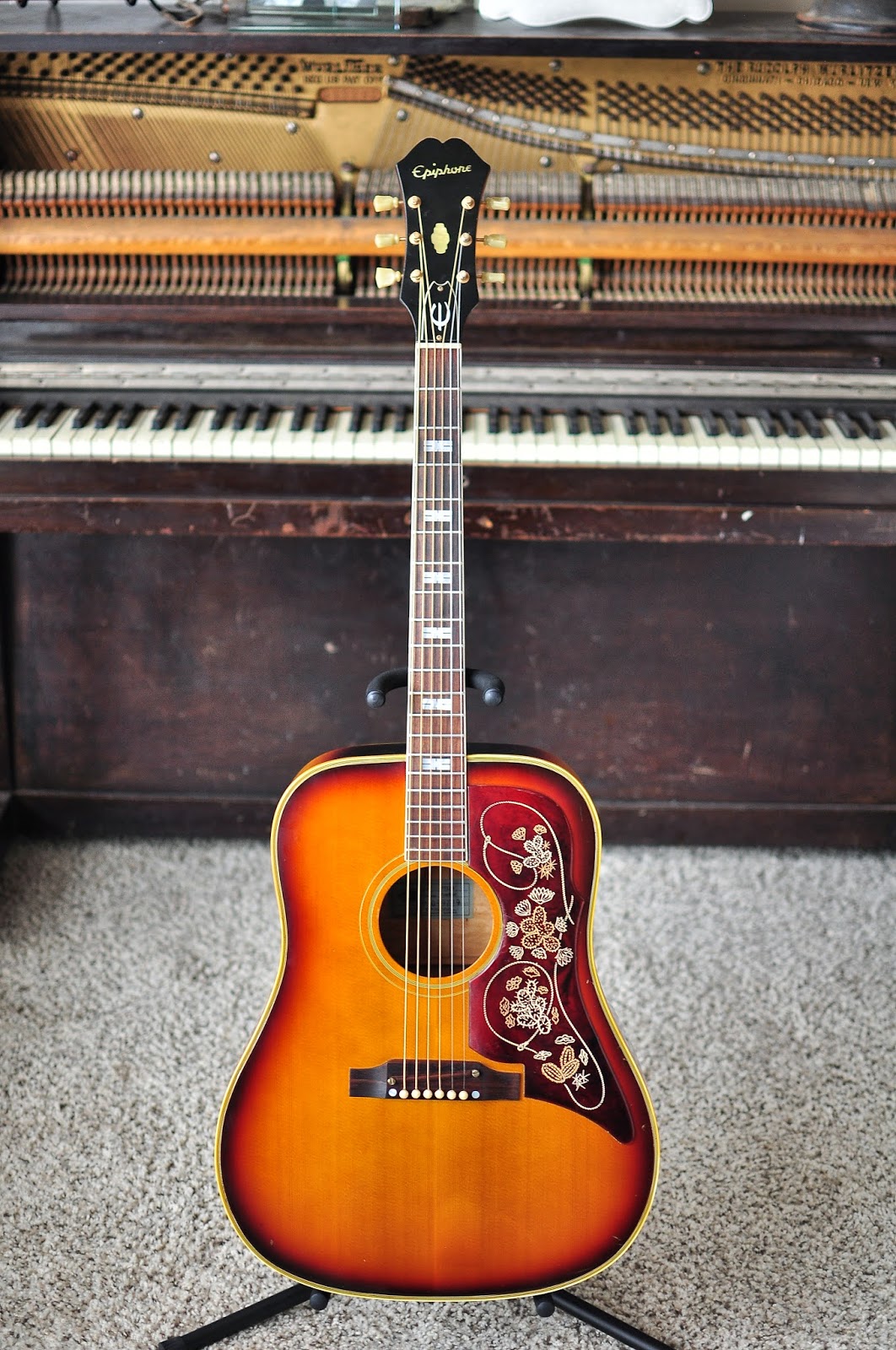
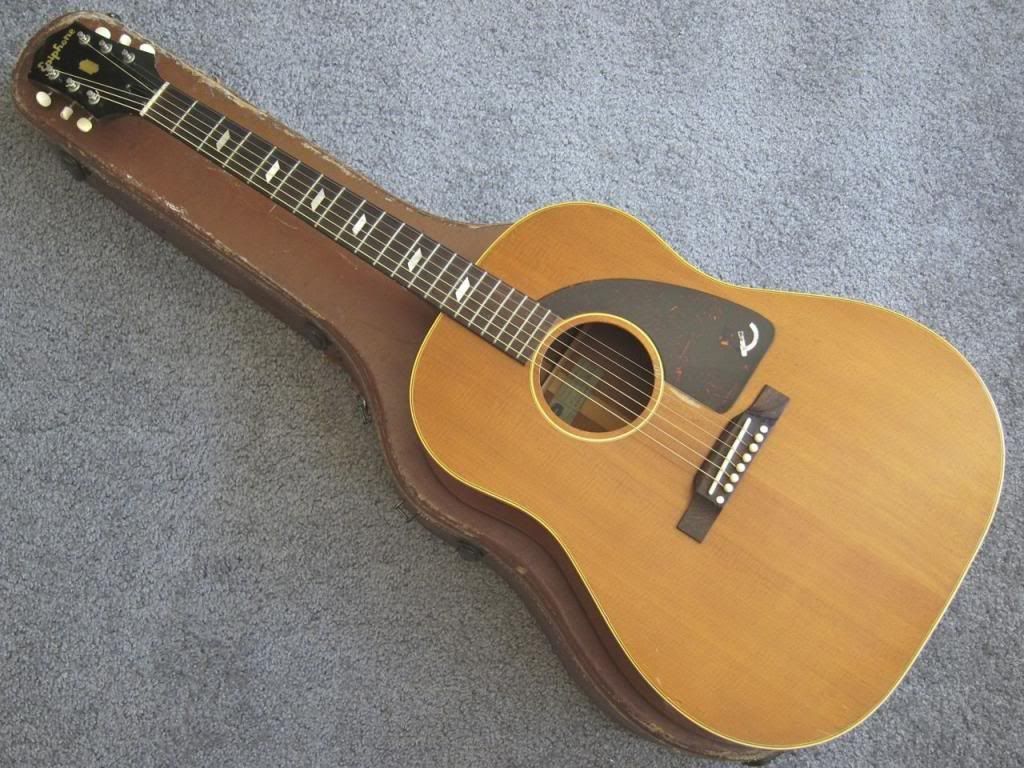
1967 Epiphone FT-110 Frontier

1967 Epiphone FT-110 Frontier


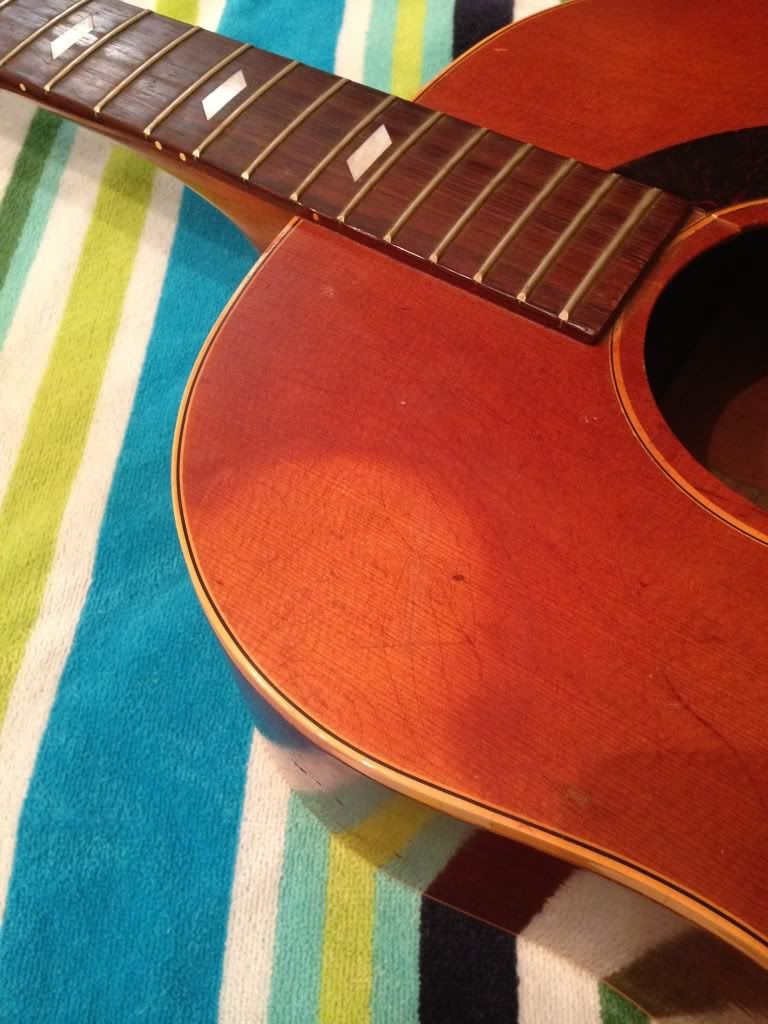
The Epiphone Frontier was manufactured by the Gibson company in Kalamazoo, MI from 1958 until 1969.  This model was a continuation of the Epiphone made FT-110 which also featured flame Maple back and sides.  The Gibson made version introduced the square shoulder design for Gibson in 1958.  In 1962, Gibson introduced the Dove which was based off of this guitar but with the bird motif.  In 1963, Gibson added the cacti and lariat relief graphic onto the pickguard of the Frontier.  Isn't that a sexy guitar?!


The time that I had with my first Frontier was all too short so I was ecstatic when I got this one in.  I purchased it with a broken and loose bridge as well as a damaged nut.  Gibson had the bad habit of gluing bridges right on top of the finish during this time period.  Glue has an easier time of staying put if the joint holds wood to wood instead of wood to finish.

I dropped it off at my luthier's place (Burn's Repair) because I know I can trust him for a professional repair.  The bridge had split into two pieces because of the weak spot in line with the bridge pins.  Jason glued the bridge back together so that the repair was almost invisible.  If you're not looking for the repair then you won't find it.  There was one spot next to the saddle that showed signs of a previous attempt at repair.  Jason removed the old glue and glued it tight.  The nut slots had been cut down too low so Jason decided it was time for a new bone nut.  The new nut is gorgeous and perfectly cut and installed.

The resulting guitar is a dream to behold.  I don't usually like to refer to guitars in such flowery language but I believe this one deserves it.  The Maple back and sides and long scale length perfectly balance out the 60s build.  The tone is low and rumbly when it wants to be.  The highs are crisp and well pronounced.  It has good volume but likely won't overpower a singer/songwriter.


I'm always on the lookout for these guitars.  Do you have one for sale?  Please contact me.


Tuesday, October 22, 2013

1936 Gibson Trojan

The first Trojan shipped in October of 1936 and was marked in the Gibson Shipping ledgers as "Trojan."  This guitar has now been confirmed in the old Gibson ledgers as a Trojan shipped on November 26, 1936.  A gentlemen posted about this guitar on the Gibson forum and was kind enough to send me a bunch of pictures.


The Gibson Trojan preceded the J-35 by a couple of months (October to December, 1936).  This Gibson Trojan matches all the features for a 1937 J-35 with the exception of a couple of key things.  The main difference is the lack of back binding.  J-35s were introduced with a single layer of binding on the back which this guitar lacks.

It also has 3 scalloped tone bars.  The standard J-35 would most likely have had 3 unscalloped tone bars.  I'm very curious about the tone of this guitar.  I'm going to guess that this thing is awesome.  Just wait until you scroll down and see the deep scallops.  Amazing.

The Ebony nut is cool but not entirely out of line.  It could have been Ebony or bone but either one would work.  It's just another aspect of this guitar that makes it so darn cool.


This guitar was made for export as evidenced by the "Made In USA" stamp on the back of the head stock.  This was fairly common at the time.  My 1937 Gibson L-00 had the same stamp and Grover branded open back tuners.  It also had the same pumpkin colored sunburst on the top but did have back binding.

I hope you enjoyed taking a look at this beauty.  Many thanks to the owner for letting me post about it.


Hear it:


Do you have one of these that you would like to sell?  I'm looking for one.  Please email me about what you have for sale.

Sunday, September 22, 2013

The first appearance of the Epiphone Texan - c.1958

These guitars baffled me for some time with their odd features.  I tried to get my hands on one but I just couldn't find an early example.  This 1958 Texan ended up coming to me.


What makes these so special

is the fact that they are an enduring example of Epiphone and Gibson history.  The body and the neck on the early Texans were made in 2 different factories.  When Epiphone sold to Gibson they shipped all the leftover parts to Philadelphia to Kalamazoo.  Gibson began building guitars out of them using everything they could.  This guitar uses two parts from Philadelphia and the rest from Kalamazoo.


The first part from Philadelphia is the mostly finished neck.  The back of the neck shows off the 5 piece laminate construction and subtle V shape found on 1950s era Epiphones.  It appears that Epiphone used Mahogany-Maple-Mahogany for the main neck structure and glued Walnut wings on the sides of the headstock.  The thrust rod cover is direct from Epiphone as well housing the hex nut on the end of the rod.  These covers must have run out early because many of the Philadelphia necked texans have a plastic cover that was most likely made by Gibson.  It's rare to find these with the shaped brass cover.


The second part that Gibson decided to re-use from Philadelphia is the laminate, unkerfed lining.  I had heard stories of solid lined Texans but I had never seen it up close.  My 1954 Epiphone FT-210 Deluxe Cutaway has the same lining so it must have been in the parts shipment from Epiphone.  


The tone

One major tonal difference in these Texans and a similar year J-45/50 is the fact that these necks are designed for a longer scale length.  A longer scale length means that the strings have to be tighter in order to sound the same note.  A higher string tension generally results in 2 things: a slightly stiffer feel and a bit more volume.  

If you haven't played many late 50s J Gibsons then this difference will be unnoticeable.  Even if you have played a lot of them the feel and tone is very familiar.  The biggest difference in player experience is the smaller nut width and subtle V shaped neck.  I found the neck to be very comfortable but a bit smaller than what I'm used too.

Is a buyout era Epiphone Texan for you?

If you interest in vintage guitars find its roots in history, design and the search for great tone then they definitely deserve a hard look.  I joke with friends about how having an American made Epiphone is the quickest test for people who like guitars.  The majority of players will see the name one the headstock and associate it with the current day market.  That guy will keep on walking and buy him a Taylor.  But every once in a while this guitar will stop someone in their tracks and make him question whether it was made in New York, Philadelphia or Kalamazoo.

Do you have one of these that you would like to sell?  I'm looking for another.  Please email me about what you have for sale.

Tuesday, September 17, 2013

1961 Silvertone 1446L


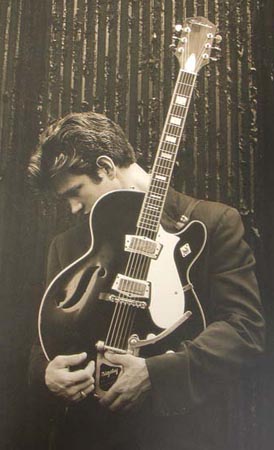
One of the greatest guitars Harmony (Silvertone) ever made was the 1446L commonly referred to as the "Chris Isaak" model.  Chris posed with this model for a couple of advertisements and also named an album "Silvertone."  What makes this guitar special is a combination of dashing looks, Gibson made and Seth Lover designed mini-humbuckers used only on this model and the Bigby vibrato.


The Gibson made miniature humbuckers really are the big attraction to this guitar.  If you want a guitar with these pickups you must buy this model or find some loose pups for sale (good luck!!).  Early production 1446 pickups came with the same "Patent Applied For" stickers as the highly sought after "PAF" pickups that came in 1957-1960 Les Pauls.  The PAFs in those Les Pauls are worth about $2000 each in good shape.  I think the 1446L is very undervalued at $1500 for one in great condition from a big vintage dealer.

The rest of the electronics are good, solid American made just like what came in an LP from that time period.  It has the same setup as well with two pickups, 2 volume and 2 tone knobs, and a 3 way switch.  The whole guitar just seems so solid even though it was manufactured by a budget company.  


I'm a big fan of the Bigsby B3 vibrato that came on these guitars.  The subtle, wavy, almost dreamy vibrato is a lot of fun to play around with.  I naturally lean towards blues licks when I'm playing so I haven't sought after guitars with vibratos.  I did seek out these pickups and I'm glad I was introduced to a good solid vibrato as a result.


If there was one drawback to this guitar it would be in the neck construction.  It does have a truss rod but doesn't taper in width from the heel to the nut.  It seems a little "cheap" at first but I got used to it very quickly and grew to really like it.  The nut width is small but I haven't measured it.


Bottom line:

This is a professional grade vintage instrument at a "prosumer" grade price.  It has the tone and feel of the early 1960s and the looks certainly don't disappoint.  This model shows no sign of declining in popularity and therefore value so it would likely be a good investment as well.  However, because of the nut width and neck construction this guitar may not be the answer for the player looking to own just one guitar.  

Do you have one of these that you would like to sell?  I'm looking for another.  Please email me about what you have for sale.


Friday, May 10, 2013

Question for Twitter: What is the best guitar?

Maybe that wasn't the best way I could have worded that.  How about:


1. What guitar have you not been able to get off of your mind?
2. If any guitar could suddenly appear in your hands, what would it be?

Both of those questions should be qualified with "right now."

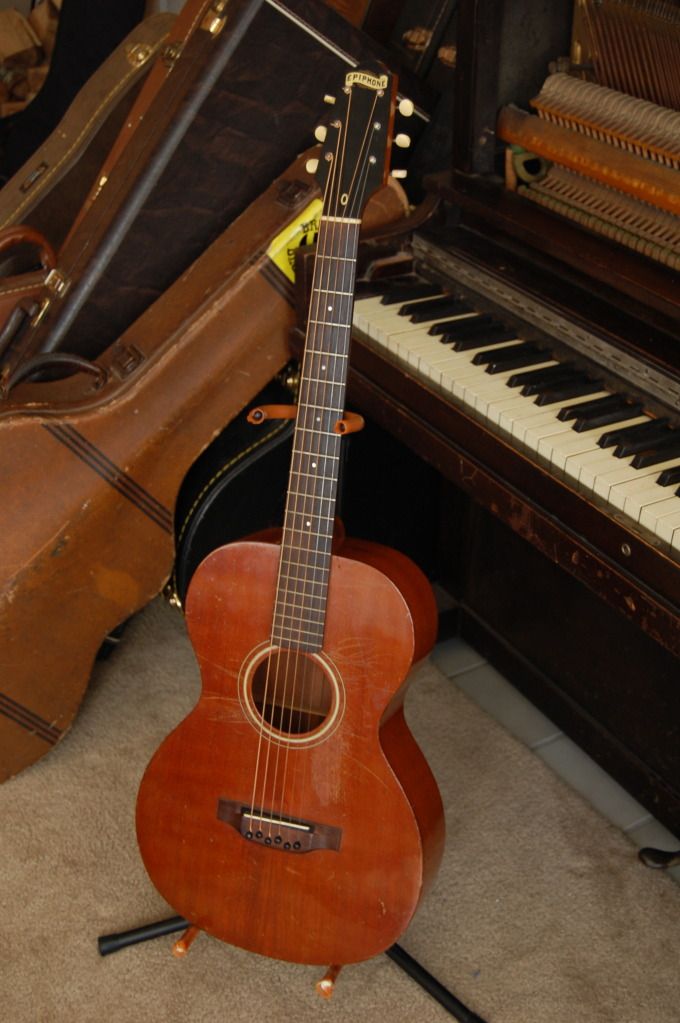
It may have looked like I was trying to start a twitter fight about brands, models, etc. but that was not my intent.  The question stemmed from a discussion I had with a friend over guitars a couple of weeks ago.  He recently started working at Gibson 5 star dealer and so began his dream of a Gibson J-200 True Vintage.  It was the pinnacle of tone and nothing else would do (paraphrased).  This was after he was really digging the weird 1930 Epiphone Model 0 I loaned him to record his debut album (Pete's Debut Album).  I had felt the same way about that guitar before as well.  There is still a soft spot in my heart for the huge tone that comes from a lightly picked fingerstyle blues on the old Epiphone.


In My Opinion

the best guitar is always the next guitar and I think that Pete would say the same thing.  There is nothing like the anticipation of an old guitar coming in the mail.  What will it sound like?  What weird features will it have that I didn't see in the pictures?

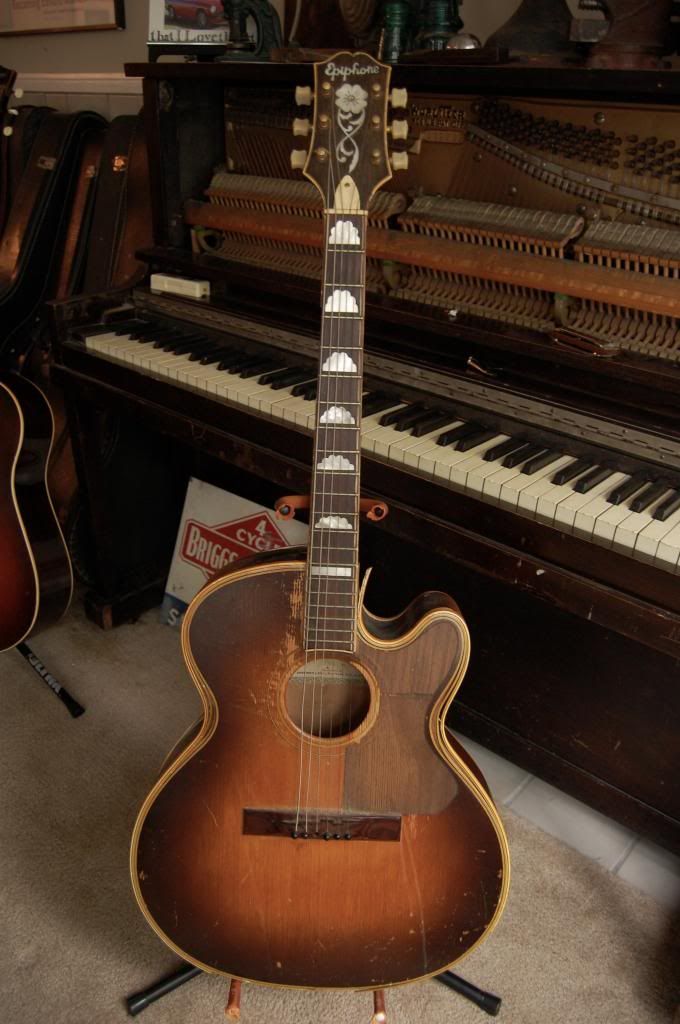
I recently bought a 1954 Epiphone FT-210 Deluxe Cutaway from a fellow in NY.  I had only seen pictures of these and could not wait to have it in my hands.  I knew that it needed work but I just didn't care.  It was the pinnacle of vintage guitars for the three and a half days that UPS had it, at least in my mind.  When it arrived I was ecstatic.  Among guitar forum geeks (such as myself) this is called an NGD or New Guitar Day.

What did it sound like?  Terrible at first, I'll admit.  I was so in love with it that I couldn't put it down.  After about two days of playing it, it really opened up and the tone was unique.  I love it now.

What weird features did it have?  It was ladder braced and had a weird compensated rosewood bridge/saddle.


The next guitar?

The Epiphone is still extremely cool only a week later but I've already got my sights set on another.  There is an eBay auction ending tomorrow on a Kalamazoo KG-12 with rare Maple back and sides.  It is a sickness!  The forum term for this sickness is GAS- Guitar Acquisition Syndrome.


Wednesday, May 8, 2013

"Buyout" Period Epiphone Texans: Parts Guitars?

By the dawn of the 1950s, the Epiphone company was struggling with problems in both the accounting and labor departments.  The company's product line hadn't kept up with the changing trends in guitars such as the new solid body electric (Gibson's Les Paul model?).  It had moved the production facilities from New York to Philadelphia in an attempt to avoid a problem with the labor union.  By 1957, the company's doom seemed imminent which forced its sale to their biggest competitor, Gibson, for the sum total of only $20,000.


American made Epiphone guitars (both during and before the Gibson buyout) are fantastic instruments.  Their relative obscurity and high standard of quality is a recipe for a very inspiring guitar.  I recently came across an immediate post-buyout Texan that has me intrigued (1959 Epiphone Texan with strange features).  The description states:

"Gibson FON on the neck block indicating 1952 manufacture, starts with a "Z"; solid, un-kerfed linings (no one has ever seen this on any modern Gibson instrument); the word GUITAR rubber-stamped on the inside of the back, between the neck block and the first back brace; black paint on the heel underneath the clear coat, which has been seen many times on various Gibsons in the 1960's."

 1952?

The body is easily dated using Gibson's backwards letter prefix used from 1952-1961.  They started with Z in '52 and ended with Q in '61.  These letters were stamped on the interior neck block and were proceeded by a batch number (usually 4 digits) then a unique rack number (the Xth number in that rack).  This guitar received a Z indicating that it was made in 1952.

Easy, right?  Not quite.  The description also states that this guitar has solid lining (as opposed to kerfed).  Lining is what gives the body's joints (top to rims and rims to back) a solid gluing surface.  Usually this lining is kerfed, meaning that it has small cuts vertically to make it bend without needed to be soaked in hot water and bent over a hot pipe.

Kerfed Lining

Solid Lining

Gibson phased out solid lining in favor of the kerfed style from 1933-1934.  I have never seen any flat-top Gibson guitar that used solid lining after 1934.  I would venture to say that Gibson did not build guitars using this kind of lining after 1934.  This is my opinion based on my experience so feel free to prove me wrong.  Edit:  I just acquired one of these guitars.  The lining is made of laminated Poplar.  The only other place I have seen this is on my 1954 Epiphone FT-210 Deluxe Cutaway.  I'm assuming Gibson got leftover strips of lining from Epiphone and used it?  Not sure.

(Edit)  At least Gibson phased out the use of solid lining made of Mahogany in 1934.  After acquiring a buyout period Texan I determined that this "solid lining" wasn't really solid.  In fact, it is made of laminated strips of what looks like Poplar.  The only other place I have seen this is on my 1954 Epiphone FT-210 Deluxe Cutaway.  Perhaps Gibson also acquired strips of unused lining from Epiphone as well as necks?

Gibson "J" body surplus

In the early 50s Gibson was selling some of their jumbo bodies to National.  National would manufacture a neck and bolt it on to a Gibson body calling it the National 1155.  These are great guitars for the vintage player on a budget but I am told that the necks are a bit difficult to get used to.  You'll have to decide that for yourself.


Since National ordered a bunch of J bodies from Gibson, they had more bodies than necks.  When a bunch of Epiphone necks showed up at Gibson's doorstep in 1957, the answer was simple.  They went downstairs to the parts basement and grabbed a bunch of J sized bodies.  That is how I would explain this guitar having a Z (1952) factory order number.

(Edit) .....but I'd be wrong.  After acquiring one of these, the tops were definitely made post 1955 judging by the bracing.  My next theory would be that Gibson needed finished bodies to sell to National.  Since National was bolting on the necks, Gibson needed bodies with uncut neck blocks (instead of cut for a dovetail joint).

When the Epiphone necks showed up in 1958 they were already cut for a dovetail joint.  Since the dovetail extension on the neck and the neck block were cut by two different manufacturers they differed to the point that they wouldn't fit right.  Gibson would need to use a body with an uncut neck block and cut it to fit the Epiphone neck.


So you have one of these short headstock Texans?  Send me some shots of yours.  Here is @guitaristo's (Instagram) 1958 Epiphone Texan that has recently been sold.  The serial on the blue label was an A-XXX number but he can't remember what was on the neck block.  I wonder if it was an earlier FON?


Why do these features even matter?

Although these Texans look like weird J-45s they are certainly not.  The main difference in a standard Texan and J-45 is the scale length.  Epiphone was using a 25.5" scale length so the necks were manufactured to this spec.  Gibson's traditional scale length and that of the J-45 is 24.75".  This alone makes for a tone that is probably louder and more piano-like than a J-45.  It also doesn't bend strings as well and may wear out your fingers a bit quicker.

This '58 Texan has more than just the scale length to set it apart from a J-45.  The body was probably manufactured in '52 which means that it differs from a '57 by the bracing.  The pre-'55 J bodies were made with scalloped braces while the post-'55s had straight braces.
(Edit):  Wrong again, TVG.  While the FON prefix was Y, the tops were definitely made in the late 50s.  The bracing is short and straight (unscalloped).

These buyout era features make for an interesting guitar.  Mine needs some braces reglued before it is playable again.  It was covered in 50 years of sweat and tar until I hit it with some Virtuoso cleaner.  Here are some shots of the clean up.


TVG


Saturday, April 27, 2013

A Banner Gibson J-45 Cloaked in Rare Flame Maple


The word "rare" gets tossed around a lot on Craigslist and eBay so I contemplated not using it in the title.  In my opinion, this one deserves it.  This is a 1943 Gibson J-45 made from a laminated flame Maple back, solid flame Maple rims and a bear claw Spruce top.  Well, at least one half of the top has some bear claw figure but it's mostly obscured by the sunburst.


Quality wood was difficult to come by during the war, especially Adirondack Spruce planks wide enough for tops.  The Gibson company had slimmed their product line down to just 6 models, only two of which were archtop style that commonly used Maple.  Because of the shortage of quality materials Gibson started using parts of guitars from the basement to piece a guitar together.  This is one of those examples.


The Maple is stained dark in an attempt to make it blend better with the Mahogany backed J-45s.  The neck on this guitar is a 5 piece Maple-Walnut lamination, also intended for use on an archtop guitar.  The bear claw figure on the top is very rare for a Gibson.  Undoubtedly this piece of Adirondack Spruce was originally tossed aside until there were no more unfigured Spruce planks left.  The bear claw figure is mostly covered by the burst but is still easily seen if you look close.  Gibson considered this figure a lower grade than the standard straight-grained Spruce.


This guitar was owned by Gladys Atkins from Porterville, Ca until her death about a decade ago.  It is unknown how it received such a great knock as to cause the headstock to break, or who did the repair.  All I know is that it is a very solid repair but boy, is it ugly!  I haven't decided what I want to do with the front.  I can't bring myself to refinish the entire front and lose the original banner.  I also don't feel confident that the lower half could be finished and blended very well with the top.  I intend to leave it as is for now at least.


The Tone

In short: loud, articulate and very unlike a typical J-45.  The Gibson J-45 model is know in part for its low-end growl and break up.  They aren't muddy like a D-28 can get in the low end.  They have this distinct overdriven low end.  This one substitutes the standard J-45 growl for articulation, note separation and sparkly top end.

This Maple J-45 still retains two tonal aspects common of the Mahogany backed J-45s.  The first is a very balanced mid-range.  It responds well across the figurative EQ curve and would record well.  The other is the Gibson thump, but it is different than the Mahogany thump.  The thump doesn't sound as bass heavy but is still pronounced.  


Gibson used solid rims on J-45s until about 1952.  At this time they started using laminated wood and discontinued using cloth side supports to protect against splitting.  Laminated wood isn't prone to splitting at the grain lines because they layer it with the grain running 90 degrees to the other layers.  I'm partial to solid rims myself, especially when they have nice flamey figure.


Do you have one of these that you would like to sell?  I'm looking for another.  Please email me about what you have for sale.


Thursday, March 21, 2013

Black Diamond Strings


Supposedly, in the old days, Black Diamond Strings were just about the only brand you could get.  I don't have any experience with them but I've been told that these things were really "stiff."  I don't have a date for this box but the price was $2.10.  Maybe 60s?

Vintage guitars are fantastic but vintage strings, well, I don't think they peaked in the 1930s or 40s.  I did a quick google search and came up with this little ditty:


TVG
Thursday, February 21, 2013

1934 Gibson L-00 from Instagram

I like to post pictures of guitars on Instagram and sometimes I will search hash tags for other old guitars.  Today I found this one, a 1934 Gibson L-00.  Neither the guitar or the pictures belong to me (unfortunately!).


This guitar, bearing the batch number 1212 - 31 was manufactured in 1934 according to Spann's Guide to Gibson: 1902-1941.  It features the smaller sunburst typical of the early 30s.  Supposedly the sunburst was small because wood supplies were not very good during the depression.  The black part of the sunburst served to cover up imperfections in the wood.


Structurally, this guitar is very similar to my '33 L-00.  One way that it differs is in the lining used to join the sides to the top and bottom of the guitar.  You can see from the photo above that this guitar has the modern, kerfed lining.  My guitar has the solid, steam bent lining.  See below:


There was a soldier overseas during World War II that wanted to someday be a touring Country Western musician.  He bought this guitar used upon his return from the war.  He followed his dream for a while but soon opted for the life of a family man instead of that of a touring musician.  He still played every once in a while with some other musicians.  He played this guitar until his death.  It was then passed on to his granddaughter where she displays it proudly on her wall.


The tuners have been changed but they look very similar to what would have been on there.  I think that these are the cheaper tuners that Harmony used on their guitars in the 60s.  Everything else on the guitar looks to be original.  I don't see any bad repairs but I don't have any shots of the underside of the top.


What a stunning little Gibson!  After I wrote this I took mine out of its case and played Mississippi John Hurt's version of "Make Me a Pallet on the Floor" and remembered why these are so popular for fingerstyle blues.

TVG