Showing posts with label J-45. Show all posts

Tuesday, March 11, 2014

1967 Epiphone FT-110 Frontier
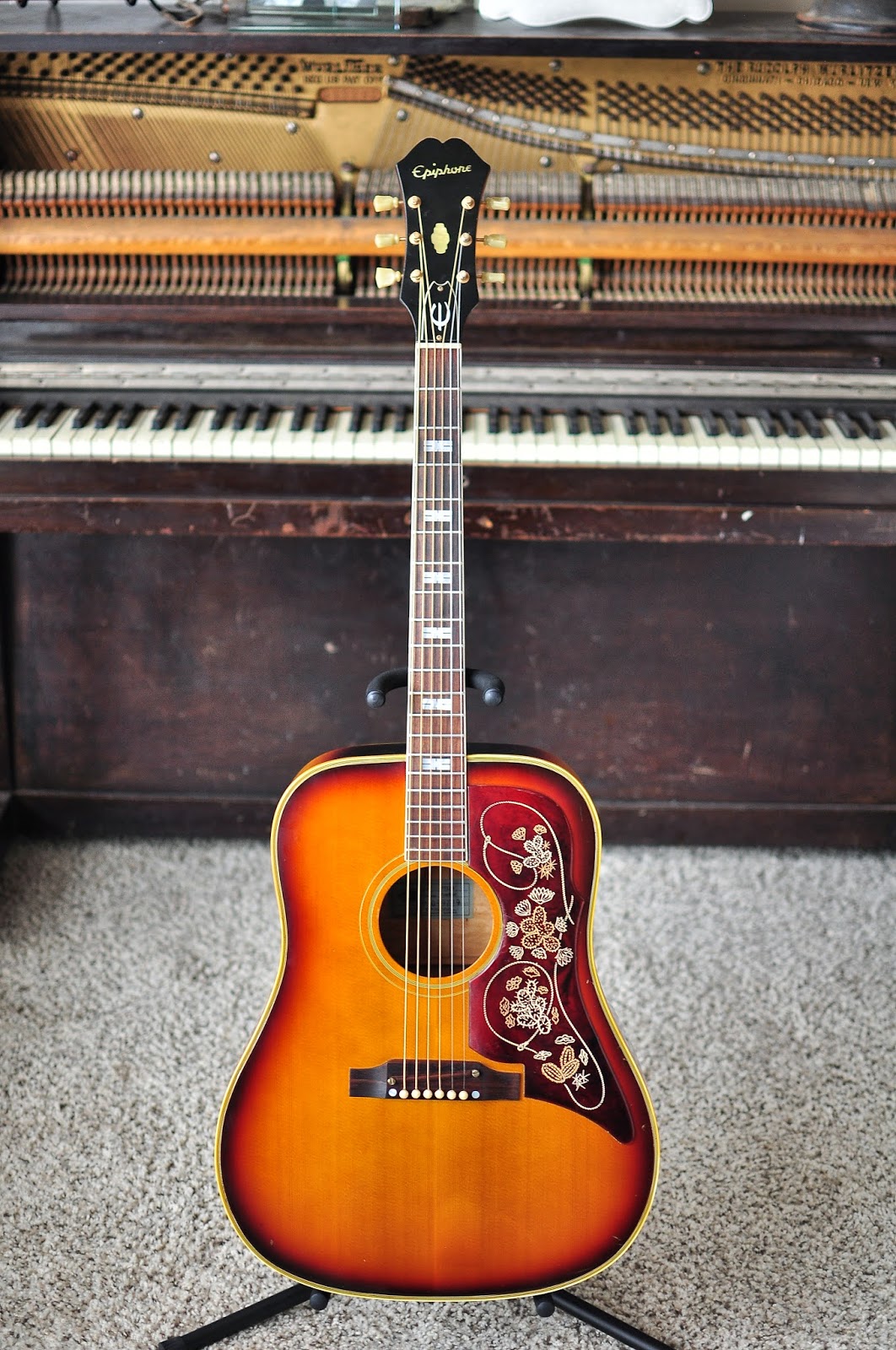
1967 Epiphone FT-110 Frontier


The Epiphone Frontier was manufactured by the Gibson company in Kalamazoo, MI from 1958 until 1969.  This model was a continuation of the Epiphone made FT-110 which also featured flame Maple back and sides.  The Gibson made version introduced the square shoulder design for Gibson in 1958.  In 1962, Gibson introduced the Dove which was based off of this guitar but with the bird motif.  In 1963, Gibson added the cacti and lariat relief graphic onto the pickguard of the Frontier.  Isn't that a sexy guitar?!


The time that I had with my first Frontier was all too short so I was ecstatic when I got this one in.  I purchased it with a broken and loose bridge as well as a damaged nut.  Gibson had the bad habit of gluing bridges right on top of the finish during this time period.  Glue has an easier time of staying put if the joint holds wood to wood instead of wood to finish.

I dropped it off at my luthier's place (Burn's Repair) because I know I can trust him for a professional repair.  The bridge had split into two pieces because of the weak spot in line with the bridge pins.  Jason glued the bridge back together so that the repair was almost invisible.  If you're not looking for the repair then you won't find it.  There was one spot next to the saddle that showed signs of a previous attempt at repair.  Jason removed the old glue and glued it tight.  The nut slots had been cut down too low so Jason decided it was time for a new bone nut.  The new nut is gorgeous and perfectly cut and installed.

The resulting guitar is a dream to behold.  I don't usually like to refer to guitars in such flowery language but I believe this one deserves it.  The Maple back and sides and long scale length perfectly balance out the 60s build.  The tone is low and rumbly when it wants to be.  The highs are crisp and well pronounced.  It has good volume but likely won't overpower a singer/songwriter.


I'm always on the lookout for these guitars.  Do you have one for sale?  Please contact me.


Saturday, April 27, 2013

A Banner Gibson J-45 Cloaked in Rare Flame Maple


The word "rare" gets tossed around a lot on Craigslist and eBay so I contemplated not using it in the title.  In my opinion, this one deserves it.  This is a 1943 Gibson J-45 made from a laminated flame Maple back, solid flame Maple rims and a bear claw Spruce top.  Well, at least one half of the top has some bear claw figure but it's mostly obscured by the sunburst.


Quality wood was difficult to come by during the war, especially Adirondack Spruce planks wide enough for tops.  The Gibson company had slimmed their product line down to just 6 models, only two of which were archtop style that commonly used Maple.  Because of the shortage of quality materials Gibson started using parts of guitars from the basement to piece a guitar together.  This is one of those examples.


The Maple is stained dark in an attempt to make it blend better with the Mahogany backed J-45s.  The neck on this guitar is a 5 piece Maple-Walnut lamination, also intended for use on an archtop guitar.  The bear claw figure on the top is very rare for a Gibson.  Undoubtedly this piece of Adirondack Spruce was originally tossed aside until there were no more unfigured Spruce planks left.  The bear claw figure is mostly covered by the burst but is still easily seen if you look close.  Gibson considered this figure a lower grade than the standard straight-grained Spruce.


This guitar was owned by Gladys Atkins from Porterville, Ca until her death about a decade ago.  It is unknown how it received such a great knock as to cause the headstock to break, or who did the repair.  All I know is that it is a very solid repair but boy, is it ugly!  I haven't decided what I want to do with the front.  I can't bring myself to refinish the entire front and lose the original banner.  I also don't feel confident that the lower half could be finished and blended very well with the top.  I intend to leave it as is for now at least.


The Tone

In short: loud, articulate and very unlike a typical J-45.  The Gibson J-45 model is know in part for its low-end growl and break up.  They aren't muddy like a D-28 can get in the low end.  They have this distinct overdriven low end.  This one substitutes the standard J-45 growl for articulation, note separation and sparkly top end.

This Maple J-45 still retains two tonal aspects common of the Mahogany backed J-45s.  The first is a very balanced mid-range.  It responds well across the figurative EQ curve and would record well.  The other is the Gibson thump, but it is different than the Mahogany thump.  The thump doesn't sound as bass heavy but is still pronounced.  


Gibson used solid rims on J-45s until about 1952.  At this time they started using laminated wood and discontinued using cloth side supports to protect against splitting.  Laminated wood isn't prone to splitting at the grain lines because they layer it with the grain running 90 degrees to the other layers.  I'm partial to solid rims myself, especially when they have nice flamey figure.


Do you have one of these that you would like to sell?  I'm looking for another.  Please email me about what you have for sale.


Thursday, March 21, 2013

Black Diamond Strings


Supposedly, in the old days, Black Diamond Strings were just about the only brand you could get.  I don't have any experience with them but I've been told that these things were really "stiff."  I don't have a date for this box but the price was $2.10.  Maybe 60s?

Vintage guitars are fantastic but vintage strings, well, I don't think they peaked in the 1930s or 40s.  I did a quick google search and came up with this little ditty:


TVG

Thursday, February 14, 2013

1943 Gibson J-45: All Mahogany, All blues

This banner Gibson J-45 was made in the lowest of low time period during World War II.  It is made from all solid Mahogany and features no steel truss rod but a solid Ebony insert down the neck for stability.  Stock piles were at there lowest point because everything was going to the war effort.  While this guitar may not be as desirable as a Spruce/Hog with truss rod guitar, it is a very cool part of Gibson history.  The neck is straight and the tone is unique and warm.  I love playing this guitar!!


When I saw this guitar and its combination of features and probably original case, I had to have it.  It was a great compliment to my Spruce banner J-45 and just looked so interesting.  I met the seller outside of a Cracker Barrel in Chattanooga and fell in love a first strum.  Something about the color of the burst just grabbed me.  I am currently waiting to get it back from my luthier after some set up work and reglue some loose braces.


As evidenced from the wear around this soundhole, this guitar has been played.  I am still trying to figure out what kind of playing style would make that!  I don't mind it though.  The rest of the guitar is pretty clean when you consider what it has been through.


This guitar did have 2 large cracks down the back of the guitar that were repaired.  They sanded and buffed this area but luckily did not overspray it.  It was tastefully done but I would rather them have just left the finish alone.  It still has the original tuners which is quite rare.  It is ever rarer that they function!


The elephant in the room has got to be the tone of this instrument so pardon my delay.  It still has the lapping thump of a banner guitar.  The highs are more rounded off and pleasant.  Sometimes the highs can be shrill on a Spruce top but not with this one.  There may be a slight decrease in volume from my Spruce banner but that could also be a variance from guitar to guitar.  The lows are warm and comfortable but don't overpower.  The mids are equally warm and present.

I should also mention the girth of this neck.  With a nut width of 1 7/8" it can be quite a handful.  It did take a couple of minutes to get used to even after playing my other banner J-45.  Since this guitar did not receive a truss rod but a big v shaped Ebony inlay down the neck, Gibson made the neck with more girth in an attempt to give the it some stability.  It seems to be working because the neck is dead straight.  This was probably not the case before they did the refret.  There is significant playing wear on the back of the neck so I'm not sure that it was because the neck was warped or because of the fret wear.  Either way it is a joy to play now and I am glad to have it in my collection.  When the maple banner gets back from the luthier I'll have to complete banner J-45 line up.

TVG

Saturday, February 9, 2013

1944 Gibson J-45 "Only a Gibson is good enough"

The banner on Gibson's wartime flat-tops appeared around June of 1942 and disappeared sometime in 1946.  It is still a but unclear why but we may know more about the banner after this book comes out: Kalamazoo Gals.  Maybe it had something to do with national pride during the war years since the Martin guitar company was still family owned and the original CF Martin was in fact, a German immigrant.  This is solely speculation though, It may have had nothing to do with Martin.


This guitar was probably made in 1944 but again, that is just a guess.  It bears no visible factory order number and may have never received one which is common for the late war years.  It was constructed of a two piece Spruce top and a solid, one piece flat-sawn Mahogany back.  The one piece back is of note because it is evidence that wood stock piles were low so "lower quality" wood was used.  The Mahogany should have been quarter sawn for appearance and strength however this process wastes more wood than the flat sawing method.  Also of note, the Kalamazoo Gals that built this guitar were told to put "back strips" on the interior of the guitar to help the two joined quarter sawn pieces of Mahogany.  Yet this guitar has a one piece back.


I mention this because the people that built this guitar were probably not men who had worked in the factory for many years.  More than likely they were "Rosie the Riveters" that filled the empty positions of men who had gone to support the war effort.  In John Thomas' book, "Kalamazoo Gals," an argument is made that these guitars were somewhat superior to other Gibsons because of the nature of the women who made them.  These women had been working with their hands all of their lives.  They may not have been making guitars but they were very skilled nonetheless.  Since the book is not out yet I cannot say that this is the exact point or argument made.  I am very excited about the book as you can imagine!


One thing that I have noticed as a pattern of the banner Gibsons is that they have a distinctive percussive "thump" that vibrates throughout the entire instrument when a string is struck.  My experience is limited since I have played only as many banners as you can count on two hands but it is certainly a pattern.  A friend once described the thump of this exact instrument to be akin to a "lapping", as if from the tongue.  I thought that was a great way to describe it since thump would indicate a bit bass heavy, which these guitars are not.  I am worthless when it comes to describing tone with words so just bear with me.


I have three banner J-45s: one spruce and mahogany, one all mahogany and one in the mail that is spruce and flame maple.  The maple banner is still in the mail and should arrive in a couple of days.  I'll be doing two more posts on the other two banners later this month.  Do you have a banner Gibson?  Send some pictures to my email at tvguit at gmail.  I don't want to post the actual email for fear of bots.

TVG