Showing posts with label spruce. Show all posts

Tuesday, September 3, 2013

1954 Epiphone FT-210 Deluxe Cutaway

Here's a rare bird!


Epiphone's Deluxe Cutaway

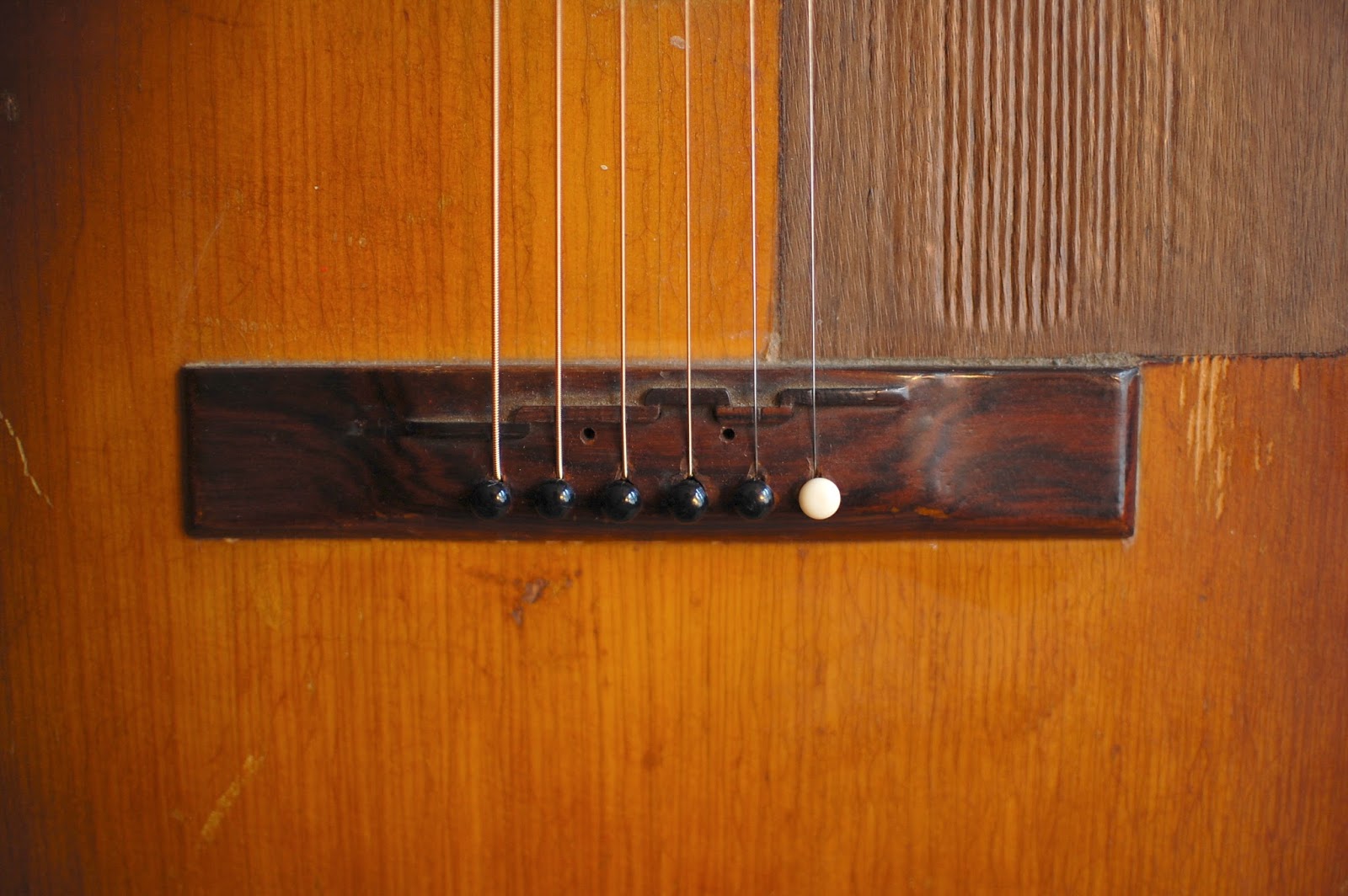
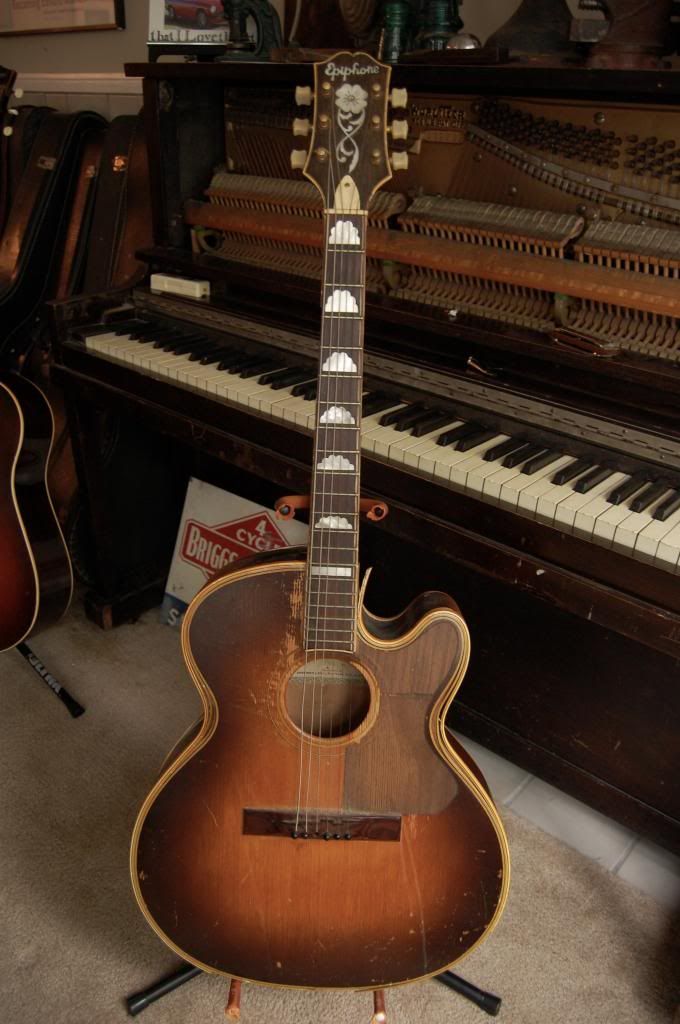
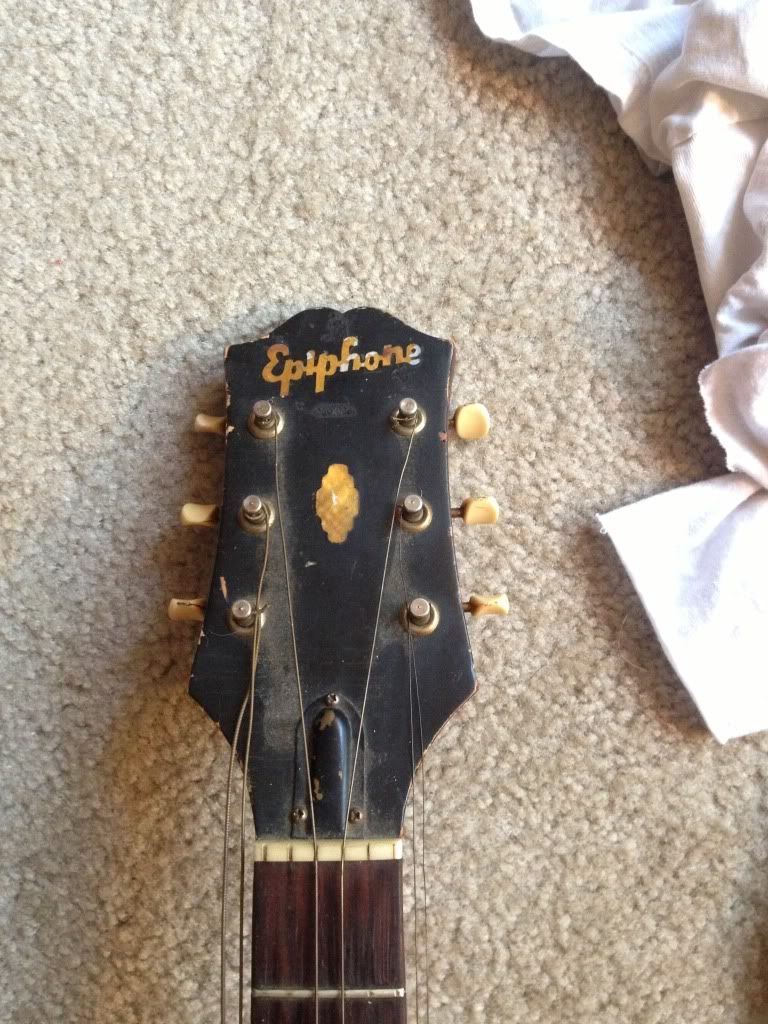
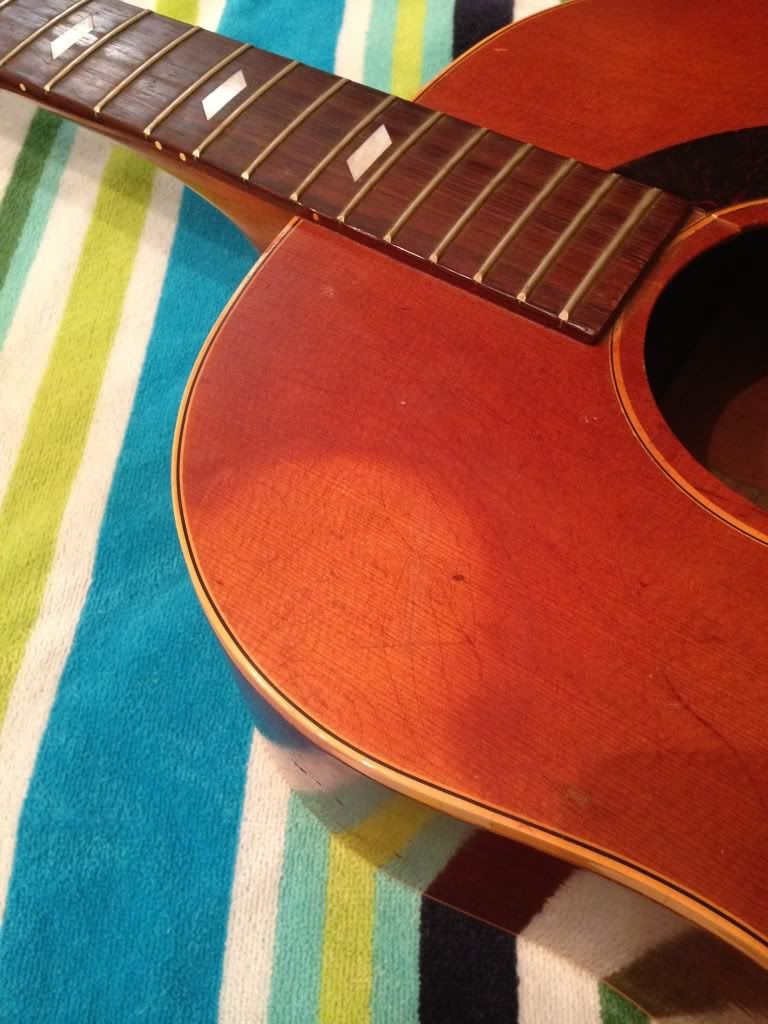
Here's a very cool 1954 Epiphone FT-210 Deluxe Cutaway.  This was Epiphone's competition to the Gibson J-200 and was actually 3/8" wider at 17 3/8" at the lower bout.  This ladder braced, long scale flat-top featured flame Maple back and sides and beautiful inlays on the neck and headstock.  The compensated Rosewood saddle would not have been my choice but is certainly an interesting addition by Epiphone.


Tone

This flat-top derives much of it's construction and aesthetics from Epiphone's line of archtop guitars.  The arched back of laminated flame Maple lends a punchy response when plucked and strummed.  The large, ladder braced top adds a dark and open timbre with medium volume.  

The compensated Rosewood saddle attempts to improve intonation problems with straight saddles.  This guitar currently needs a neck reset so I can't remark how much it helps.  Theoretically, the compensation is a good idea.  The Rosewood, however, doesn't seem to transfer vibrations to the top as well as a traditional bone saddle.  


Do you have one of these that you would like to sell?  I'm looking for another.  Please email me about what you have for sale.


Friday, May 10, 2013

Question for Twitter: What is the best guitar?

Maybe that wasn't the best way I could have worded that.  How about:


1. What guitar have you not been able to get off of your mind?
2. If any guitar could suddenly appear in your hands, what would it be?

Both of those questions should be qualified with "right now."

It may have looked like I was trying to start a twitter fight about brands, models, etc. but that was not my intent.  The question stemmed from a discussion I had with a friend over guitars a couple of weeks ago.  He recently started working at Gibson 5 star dealer and so began his dream of a Gibson J-200 True Vintage.  It was the pinnacle of tone and nothing else would do (paraphrased).  This was after he was really digging the weird 1930 Epiphone Model 0 I loaned him to record his debut album (Pete's Debut Album).  I had felt the same way about that guitar before as well.  There is still a soft spot in my heart for the huge tone that comes from a lightly picked fingerstyle blues on the old Epiphone.


In My Opinion

the best guitar is always the next guitar and I think that Pete would say the same thing.  There is nothing like the anticipation of an old guitar coming in the mail.  What will it sound like?  What weird features will it have that I didn't see in the pictures?

I recently bought a 1954 Epiphone FT-210 Deluxe Cutaway from a fellow in NY.  I had only seen pictures of these and could not wait to have it in my hands.  I knew that it needed work but I just didn't care.  It was the pinnacle of vintage guitars for the three and a half days that UPS had it, at least in my mind.  When it arrived I was ecstatic.  Among guitar forum geeks (such as myself) this is called an NGD or New Guitar Day.

What did it sound like?  Terrible at first, I'll admit.  I was so in love with it that I couldn't put it down.  After about two days of playing it, it really opened up and the tone was unique.  I love it now.

What weird features did it have?  It was ladder braced and had a weird compensated rosewood bridge/saddle.


The next guitar?

The Epiphone is still extremely cool only a week later but I've already got my sights set on another.  There is an eBay auction ending tomorrow on a Kalamazoo KG-12 with rare Maple back and sides.  It is a sickness!  The forum term for this sickness is GAS- Guitar Acquisition Syndrome.


Wednesday, May 8, 2013

"Buyout" Period Epiphone Texans: Parts Guitars?

By the dawn of the 1950s, the Epiphone company was struggling with problems in both the accounting and labor departments.  The company's product line hadn't kept up with the changing trends in guitars such as the new solid body electric (Gibson's Les Paul model?).  It had moved the production facilities from New York to Philadelphia in an attempt to avoid a problem with the labor union.  By 1957, the company's doom seemed imminent which forced its sale to their biggest competitor, Gibson, for the sum total of only $20,000.


American made Epiphone guitars (both during and before the Gibson buyout) are fantastic instruments.  Their relative obscurity and high standard of quality is a recipe for a very inspiring guitar.  I recently came across an immediate post-buyout Texan that has me intrigued (1959 Epiphone Texan with strange features).  The description states:

"Gibson FON on the neck block indicating 1952 manufacture, starts with a "Z"; solid, un-kerfed linings (no one has ever seen this on any modern Gibson instrument); the word GUITAR rubber-stamped on the inside of the back, between the neck block and the first back brace; black paint on the heel underneath the clear coat, which has been seen many times on various Gibsons in the 1960's."

 1952?

The body is easily dated using Gibson's backwards letter prefix used from 1952-1961.  They started with Z in '52 and ended with Q in '61.  These letters were stamped on the interior neck block and were proceeded by a batch number (usually 4 digits) then a unique rack number (the Xth number in that rack).  This guitar received a Z indicating that it was made in 1952.

Easy, right?  Not quite.  The description also states that this guitar has solid lining (as opposed to kerfed).  Lining is what gives the body's joints (top to rims and rims to back) a solid gluing surface.  Usually this lining is kerfed, meaning that it has small cuts vertically to make it bend without needed to be soaked in hot water and bent over a hot pipe.

Kerfed Lining

Solid Lining

Gibson phased out solid lining in favor of the kerfed style from 1933-1934.  I have never seen any flat-top Gibson guitar that used solid lining after 1934.  I would venture to say that Gibson did not build guitars using this kind of lining after 1934.  This is my opinion based on my experience so feel free to prove me wrong.  Edit:  I just acquired one of these guitars.  The lining is made of laminated Poplar.  The only other place I have seen this is on my 1954 Epiphone FT-210 Deluxe Cutaway.  I'm assuming Gibson got leftover strips of lining from Epiphone and used it?  Not sure.

(Edit)  At least Gibson phased out the use of solid lining made of Mahogany in 1934.  After acquiring a buyout period Texan I determined that this "solid lining" wasn't really solid.  In fact, it is made of laminated strips of what looks like Poplar.  The only other place I have seen this is on my 1954 Epiphone FT-210 Deluxe Cutaway.  Perhaps Gibson also acquired strips of unused lining from Epiphone as well as necks?

Gibson "J" body surplus

In the early 50s Gibson was selling some of their jumbo bodies to National.  National would manufacture a neck and bolt it on to a Gibson body calling it the National 1155.  These are great guitars for the vintage player on a budget but I am told that the necks are a bit difficult to get used to.  You'll have to decide that for yourself.


Since National ordered a bunch of J bodies from Gibson, they had more bodies than necks.  When a bunch of Epiphone necks showed up at Gibson's doorstep in 1957, the answer was simple.  They went downstairs to the parts basement and grabbed a bunch of J sized bodies.  That is how I would explain this guitar having a Z (1952) factory order number.

(Edit) .....but I'd be wrong.  After acquiring one of these, the tops were definitely made post 1955 judging by the bracing.  My next theory would be that Gibson needed finished bodies to sell to National.  Since National was bolting on the necks, Gibson needed bodies with uncut neck blocks (instead of cut for a dovetail joint).

When the Epiphone necks showed up in 1958 they were already cut for a dovetail joint.  Since the dovetail extension on the neck and the neck block were cut by two different manufacturers they differed to the point that they wouldn't fit right.  Gibson would need to use a body with an uncut neck block and cut it to fit the Epiphone neck.


So you have one of these short headstock Texans?  Send me some shots of yours.  Here is @guitaristo's (Instagram) 1958 Epiphone Texan that has recently been sold.  The serial on the blue label was an A-XXX number but he can't remember what was on the neck block.  I wonder if it was an earlier FON?


Why do these features even matter?

Although these Texans look like weird J-45s they are certainly not.  The main difference in a standard Texan and J-45 is the scale length.  Epiphone was using a 25.5" scale length so the necks were manufactured to this spec.  Gibson's traditional scale length and that of the J-45 is 24.75".  This alone makes for a tone that is probably louder and more piano-like than a J-45.  It also doesn't bend strings as well and may wear out your fingers a bit quicker.

This '58 Texan has more than just the scale length to set it apart from a J-45.  The body was probably manufactured in '52 which means that it differs from a '57 by the bracing.  The pre-'55 J bodies were made with scalloped braces while the post-'55s had straight braces.
(Edit):  Wrong again, TVG.  While the FON prefix was Y, the tops were definitely made in the late 50s.  The bracing is short and straight (unscalloped).

These buyout era features make for an interesting guitar.  Mine needs some braces reglued before it is playable again.  It was covered in 50 years of sweat and tar until I hit it with some Virtuoso cleaner.  Here are some shots of the clean up.


TVG


Saturday, April 27, 2013

A Banner Gibson J-45 Cloaked in Rare Flame Maple


The word "rare" gets tossed around a lot on Craigslist and eBay so I contemplated not using it in the title.  In my opinion, this one deserves it.  This is a 1943 Gibson J-45 made from a laminated flame Maple back, solid flame Maple rims and a bear claw Spruce top.  Well, at least one half of the top has some bear claw figure but it's mostly obscured by the sunburst.


Quality wood was difficult to come by during the war, especially Adirondack Spruce planks wide enough for tops.  The Gibson company had slimmed their product line down to just 6 models, only two of which were archtop style that commonly used Maple.  Because of the shortage of quality materials Gibson started using parts of guitars from the basement to piece a guitar together.  This is one of those examples.


The Maple is stained dark in an attempt to make it blend better with the Mahogany backed J-45s.  The neck on this guitar is a 5 piece Maple-Walnut lamination, also intended for use on an archtop guitar.  The bear claw figure on the top is very rare for a Gibson.  Undoubtedly this piece of Adirondack Spruce was originally tossed aside until there were no more unfigured Spruce planks left.  The bear claw figure is mostly covered by the burst but is still easily seen if you look close.  Gibson considered this figure a lower grade than the standard straight-grained Spruce.


This guitar was owned by Gladys Atkins from Porterville, Ca until her death about a decade ago.  It is unknown how it received such a great knock as to cause the headstock to break, or who did the repair.  All I know is that it is a very solid repair but boy, is it ugly!  I haven't decided what I want to do with the front.  I can't bring myself to refinish the entire front and lose the original banner.  I also don't feel confident that the lower half could be finished and blended very well with the top.  I intend to leave it as is for now at least.


The Tone

In short: loud, articulate and very unlike a typical J-45.  The Gibson J-45 model is know in part for its low-end growl and break up.  They aren't muddy like a D-28 can get in the low end.  They have this distinct overdriven low end.  This one substitutes the standard J-45 growl for articulation, note separation and sparkly top end.

This Maple J-45 still retains two tonal aspects common of the Mahogany backed J-45s.  The first is a very balanced mid-range.  It responds well across the figurative EQ curve and would record well.  The other is the Gibson thump, but it is different than the Mahogany thump.  The thump doesn't sound as bass heavy but is still pronounced.  


Gibson used solid rims on J-45s until about 1952.  At this time they started using laminated wood and discontinued using cloth side supports to protect against splitting.  Laminated wood isn't prone to splitting at the grain lines because they layer it with the grain running 90 degrees to the other layers.  I'm partial to solid rims myself, especially when they have nice flamey figure.


Do you have one of these that you would like to sell?  I'm looking for another.  Please email me about what you have for sale.


Saturday, February 9, 2013

1944 Gibson J-45 "Only a Gibson is good enough"

The banner on Gibson's wartime flat-tops appeared around June of 1942 and disappeared sometime in 1946.  It is still a but unclear why but we may know more about the banner after this book comes out: Kalamazoo Gals.  Maybe it had something to do with national pride during the war years since the Martin guitar company was still family owned and the original CF Martin was in fact, a German immigrant.  This is solely speculation though, It may have had nothing to do with Martin.


This guitar was probably made in 1944 but again, that is just a guess.  It bears no visible factory order number and may have never received one which is common for the late war years.  It was constructed of a two piece Spruce top and a solid, one piece flat-sawn Mahogany back.  The one piece back is of note because it is evidence that wood stock piles were low so "lower quality" wood was used.  The Mahogany should have been quarter sawn for appearance and strength however this process wastes more wood than the flat sawing method.  Also of note, the Kalamazoo Gals that built this guitar were told to put "back strips" on the interior of the guitar to help the two joined quarter sawn pieces of Mahogany.  Yet this guitar has a one piece back.


I mention this because the people that built this guitar were probably not men who had worked in the factory for many years.  More than likely they were "Rosie the Riveters" that filled the empty positions of men who had gone to support the war effort.  In John Thomas' book, "Kalamazoo Gals," an argument is made that these guitars were somewhat superior to other Gibsons because of the nature of the women who made them.  These women had been working with their hands all of their lives.  They may not have been making guitars but they were very skilled nonetheless.  Since the book is not out yet I cannot say that this is the exact point or argument made.  I am very excited about the book as you can imagine!


One thing that I have noticed as a pattern of the banner Gibsons is that they have a distinctive percussive "thump" that vibrates throughout the entire instrument when a string is struck.  My experience is limited since I have played only as many banners as you can count on two hands but it is certainly a pattern.  A friend once described the thump of this exact instrument to be akin to a "lapping", as if from the tongue.  I thought that was a great way to describe it since thump would indicate a bit bass heavy, which these guitars are not.  I am worthless when it comes to describing tone with words so just bear with me.


I have three banner J-45s: one spruce and mahogany, one all mahogany and one in the mail that is spruce and flame maple.  The maple banner is still in the mail and should arrive in a couple of days.  I'll be doing two more posts on the other two banners later this month.  Do you have a banner Gibson?  Send some pictures to my email at tvguit at gmail.  I don't want to post the actual email for fear of bots.

TVG

Sunday, January 27, 2013

1939 Gibson J-35, 3 tone bars of blues.

The model designation "J-35" showed up in the ledgers in late 1936.  It was a no frills jumbo featuring a Spruce top and Mahogany back and sides.  It was originally named the "Trojan" but not for very long.  It is my understanding that the word Trojan only shows up one time.  The Trojan guitar differs very little from the J-35, if at all.

-Edit-  As our friend mentioned in the comments section, the "Trojan" model appears 39 times in the surviving shipping ledgers from 1936.  Only one had an attached FON: 960-12 which shipped to Ridders Music Store in Atlanta.  This guitar still lives in Atlanta and while I do not know the owner personally I have interacted with him on the Gibson forum.  He is a well respected collector and I hope to one day be able check out the collection in person.  I live only 2 hours west of Atlanta!  There is a lot of TVG material there.  Thanks, Anonymous!


The J-35 was produced up until 1942 when Gibson introduced the next and more common J-45.  This J-35 was made in 1939 which was the first year that the natural finish was offered.  It was also the last year of the 3 tone bar bracing.  That makes this one a bit easier to date since Spann's Guide to Gibson does not have very many factory order numbers from 1939.


This guitar was being sold locally and was described as a "1939 Gibson L-00."  I am still trying to figure out how they nailed the year perfectly but were terribly mistaken on the model.  I tried to tell the seller what it actually was but, as is common with sellers, they don't want you to tell them what they should already know.


When I opened the case for the first time I was very surprised at how good of condition it was in.  This guitar survived in a chipboard case in someone's basement for many, many years.  The seller told me it had some water damage but he repaired it.  That was not what I wanted to hear but upon inspection, he did a pretty good job.  I was expecting sloppy glue work and half-assed overspray but was pleasantly surprised to find neither.  There was plenty of evidence of water damage but it was on the bottom near the end pin.  It wasn't a perfect repair but it was done well.  I wouldn't have expected much better from my own luthier.  He then told me he was a wood worker so it made a little more sense.


I bought this guitar 5 days before the Orlando Guitar Expo and had already bought a booth to show some guitars.  I took this one because I just couldn't resist.  It sold the morning of the first day to a very happy buyer.  I was sad, yes, but it had to be done.  I had spent the last bit of our savings including my wife's last couple of paychecks!  Not a great way to buy a guitar but I had a pretty good feeling about this one.  It seemed to work out but now there is a big J-35 shaped hole in my heart.  I guess that is one of the things that keep me going.

TVG


Tuesday, October 16, 2012

Just a good, southern late 50s Gibson J-45.. and a quick video of my 1964 Gibson B-25

Carl posted about this guitar in the comments section of the post of my 1953 J-45:


I love getting these emails.  You never know what you are going to come across.  This one has 20 frets to the body, larger pickguard and non-adjustable bridge.  That would put it between 1955 and 1961 (about).  I don't have a picture of the FON so I can't nail down the year.  I have an up close picture of the fretboard and it looks to be flat-sawn Rosewood instead of quarter-sawn.  My 1960 Gibson Melody Maker has that same kind of ugly flat sawn Rosewood.  Could be 1960?

This was Carl's dad's guitar that was bought second hand from an old lady who had listed in the local paper.  I won't tell you how much he paid but it was less than 3 digits.  Good deal!!  Carl's dad never learned to play so it hasn't seen much playing time.  Hold on to that one, Carl!!


On a separate note, here is a video I took today of a Gibson I am currently selling on eBay:


Subscribe to my YouTube channel if you want to see some more videos of vintage guitars!  I'll be uploading some videos of my J-45s and other guit-fiddles soon (hopefully).


This is a 1964 Gibson B-25.  Despite the total refinish, it really is a nice guitar.  I haven't played many Gibsons with ADJ bridges and I had always been told how bad they sound.  Maybe my expectations were low but I really like the way it sounds.  The high "e" string really rings true and loud.  It still has that little percussive "thump" in the body when you strike a string.

I am also very fond of this tune called "Murder In the City" by the Avett Brothers.  I did you the favor of not singing it in the video.  You're welcome.


Monday, August 27, 2012

50s Kay Kraftsman Jumbo.... The poor man's J-200

I saw an old amp on Craigslist in Tuscaloosa the other day.  It was a Silvertone 1472 sporting about 10 watts or so and a 12" speaker.  I was heading to Tuscaloosa on business that day so I figured I would inquire about it.  Unfortunately I was about 10 minutes too late.

The seller was very nice and asked what else I was interested in.  I told him I like anything old and made in America.  He said he had an old Kay flat top that had a body made by Gibson.  I thought to myself, "I've heard that before."


The body was not made by Gibson but that didn't matter to me.  This is a mid 1950s Kay (Harmony) Jumbo (actual model? I dunno.  Maybe just Kraftsman).  It was made in Chicago and features a solid Spruce top, solid one piece flame Maple back and veneer sides.  It has 17" wide hips (a regular dreadnought is 16") and has ladder bracing.  It is original save for the Guild bridge added sometime long ago.  It even came with the original Kluson tuners!


I was drawn to this guitar for three reasons: the size, appointments and the FLAME MAPLE BACK!  This is an absolutely beautiful slab of maple.  They didn't even cut it in half and book match it.  It is just one solid piece of sexy Maple.


She came to me in pretty good shape except that the neck was falling out and there was no nut or saddle.  I was very excited to have another neck reset project.  My last one didn't go so well but I learned a lot from it.  You can read all you want about it but there is not substitute for just doing it.  I highly suggest it if you are so inclined and have a suitable subject (ie not Gibson).


This is a dovetail joint.  It requires skilled craftsmanship to make and fit the neck to the guitar at just the right angle.  It takes a lot more time and human attention than a bolt on neck.  Dovetail joints are not easily made by machines.  They are a sign of old world craftsmanship.  Do you own a Taylor?  Your guitar probably does not have one of these.


I was really excited to see no gaps when I was done!  These are crappy cell phone shots.  I forgot to take real pictures.  I didn't want any good evidence in case it went bad.


The wife was kind enough to let me turn the apartment into a repair shop.  It was a mess and still kind of is.  This is a shot of me cutting the me bone nut.  It was my first full nut made from scratch.  I was happy with the result since it was my first try.  I will definitely do some things differently next time.

This is an interesting guitar because it has a 26" scale length.  That is the distance from the saddle (the white piece on the bridge) to the nut (the white piece at the top of the neck).  The standard scale length for a Gibson is 24 3/4" and the standard Martin scale is 25 1/2".  This is significant in both the way it plays and sounds.  A longer scale means that the strings must be tighter in order to sound the note.  This  usually makes for a louder and more difficult to play instrument (on average).  The tighter the string is the more difficult it is to push the string down to the fret.  Needless to say, this thing is a hoss to play and sounds great!


Another interesting feature (or lack thereof) is the absence of a truss rod.  Maybe it was just an attempt to save money.  They accounted for this by making the neck a monster.  It is by far the biggest neck I have ever seen.  It really gives it that 40s and 50s feel.  The neck is straight as an arrow so I guess they called Time's bluff.
I really like the peghead overlay on this one.  They used a celluloid overlay and carved and painted the detail and logo with white and gold paint.  I was talking with a friend about this guitar and he made a good point about how the peghead is very underused and plain on most guitars.  I agreed and thought that this was one of the most beautiful headstocks I have ever seen.  

Enough talk.  Let's pick.