Showing posts with label how to date vintage gibson guitar. Show all posts

Wednesday, January 9, 2013

Another Nick Lucas.... This one is probably a little later

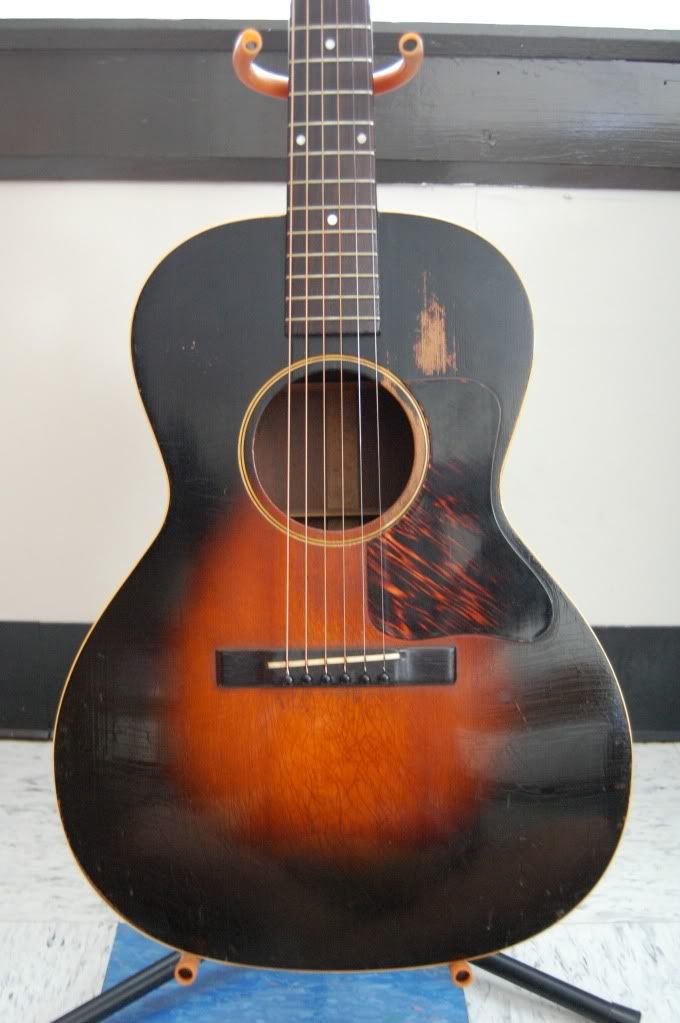
This Nick Lucas walked into the local shop that I frequent.   My ears perked up when I heard about it even though I knew it was a bit rough.  Since there were only 57 (but about 200 have been found/documented, an estimated 400 total produced thanks to some forum knowledge, thanks TM) documented Nick Lucas Specials produced in any body style, one showing up locally is quite an occurrence.


I told you it was rough, but I could not care any less.  The Gibson Nick Lucas Special is my favorite flat-top guitar ever.  What makes them so special is the combination of appointments, scarcity and body depth.  Of course, I am not the only one who thinks the NL is special.  Here is Bob Dylan with his.


The first Nick Lucas Special is believed to have been produced in 1928 with a list price of $125.  The first models shared the same body dimensions as the L-1 and L-3 (like the previous NLS that I wrote about).  This guitar features the 0 and 00 body width but retains the deeper body much like the L-1.  It also has 14 frets clear of the body instead of 12.  The serial numbers on NLS guitars often date to '28 or '29 even though they were often made much later.  I don't have the FON on this one but I would guess '34, '35 or '36 because of width of the burst and the Maple back and sides.  


Here is a shot of the interior.  I don't think the interior of this guitar has been worked on much because I don't see any ugly reglued braces.  You can pretty easily see the loose back braces.  I would venture to guess that they would just fall out if you nudged them.  The top braces are probably in about the same condition.  The owner is taking no chances on this guitar: he is sending it to Ren Ferguson of Gibson Montana fame.  Ren is not only responsible for turning Gibson's acoustic offerings around at the end of the 80s but is also a top notch guy.  He took the time to talk to me (just a nerdy guitar kid) about how they came up with the idea for using Walnut on the Gibson Jackson Browne Signature model among other things.


I am absolutely thrilled that the owner decided to send this guitar to Ren.  The guitar may even be more valuable just because Ren worked on it (at least it is to me!).  It will probably take him a long time since Ren has been quite busy as of late.  You may have heard that he is working with Fender (Guild).


Here is the back of the Nick.  You can see the gorgeous flame maple peeking through that Cremona Brown sunburst.  It has plenty of nicks and scratches but it really isn't that bad.  I don't think it was even dusted off at the time of this picture.  Looks like whoever played it used one of those nasty capos that took chunks out of the back of the neck.  Pet peeve of mine.


Here is the label on the Nick.  I love seeing the hand written model numbers/names.  The handwriting is usually very elegant which is very rare these days.  I know my handwriting is terrible!  This appears to have been filled out in error though.  The space after "Gibson" should say "GUITAR" and the style should say "Nick Lucas Special."  I thought at first that this was even the wrong label but a friend from a forum informed me that the they used this label on the Maple NLSs.  The original label looked like this:


I'm not sure if they ran out of them or just stopped using them.  That is one interesting thing about Nicks is that they often have strange features.  As my friend says about Gibsons, "If it perfectly matches the description then it is probably fake."  They had a couple of different body shapes, 3 different types of wood for the back/sides and many different style bridges.  These are true custom made guitars.  It is estimated that 300-400 were produced over 11 years in a time where Gibson was slapping guitars together with whatever they had around.


Here is one repair we can clearly see.  The fretboard has been planed about halfway down.  I'm not sure if that was a result of a neck set or a couple of refrets.  I will guess that it is a result of a whole bunch of refrets because the fret wire they used was much softer than what they use now.  I didn't really see any evidence of a neck set either.  Although, I know it will need a neck set now. 

Leave it to Ren,  he will get this sad looking Nick in tip top shape.  I'll do another post when it comes back.  I might be able to include a video!  We will see what the owner will allow.

TVG


Thursday, January 3, 2013

1928 Gibson Nick Lucas... from an email

I'm active on a couple of guitar nerd forums and I like to look out for cool guitars.  The Gibson Nick Lucas Special is one of my all-time favorite guitars ever produced.  Here is an email that I got from the grandson of the original owner of this guitar:


My grandfather bought a new Gibson Nick Lucas back in the twenties. He never got around to learning how to play it and it sat in its case until he gave it to my brother in the late Fifties. It sat under his bed until I found it in the early Sixties.

It had been strung up and ignored for decades. The action was redunkulous. I didn't know any better since it was the first guitar I had ever touched. Many sore fingers later I heard about light gauge strings and tuning down. In the meantime it was handled with absolutely no care by an ignorant teenager - me. I dropped a clock radio on it, several times - note the huge gouges. 

Eventually i took it to a guitar shop where they "improved" it by filing down the original bridge to get the action a little better. I took off the open gear tuners and drilled holes for shiny new closed gear Grovers. The tuners were a great improvement, but - now the guitar wouldn't fit in the case unless I took off the D and G pegs!

I got a Dearmond soundhole pickup and played slide for quite awhile. I had a neck reset in the Nineties and have been playing fingerstyle with it tuned down a whole step ever since. 

According to the guys at Gibson, the serial number (in pencil) on the label indicates it was made in 1926 but that doesn't match up with the description on the Gibson Nick Lucas reference page. Mine has the pearl "The Gibson" and the notched diamond inlay at the third fret. It is a 12 fretter so my best guess is late 1928. That makes it 85 years old sometime this year. August 22 is Nick Lucas's birthday. :)

This guitar has been rode hard and put away wet. It is LOUD! It sounds clear and true. Rings for days. Playing up towards the neck produces a wide warm tone and playing down by the bridge gets a crisp sound. This is true of every guitar but is really remarkable on my Nick. The "improvements" and hard wear probably make it a lot less desirable to a collector, but I have no plans of setting it loose in this lifetime.  

Neither of my sons plays guitar but maybe my grandson will someday.   

It is very rare to have a full history on a guitar.  Thank you BmoreTele for sending me this.  A very cool guitar indeed.


TVG 

Tuesday, October 16, 2012

Just a good, southern late 50s Gibson J-45.. and a quick video of my 1964 Gibson B-25

Carl posted about this guitar in the comments section of the post of my 1953 J-45:


I love getting these emails.  You never know what you are going to come across.  This one has 20 frets to the body, larger pickguard and non-adjustable bridge.  That would put it between 1955 and 1961 (about).  I don't have a picture of the FON so I can't nail down the year.  I have an up close picture of the fretboard and it looks to be flat-sawn Rosewood instead of quarter-sawn.  My 1960 Gibson Melody Maker has that same kind of ugly flat sawn Rosewood.  Could be 1960?

This was Carl's dad's guitar that was bought second hand from an old lady who had listed in the local paper.  I won't tell you how much he paid but it was less than 3 digits.  Good deal!!  Carl's dad never learned to play so it hasn't seen much playing time.  Hold on to that one, Carl!!


On a separate note, here is a video I took today of a Gibson I am currently selling on eBay:


Subscribe to my YouTube channel if you want to see some more videos of vintage guitars!  I'll be uploading some videos of my J-45s and other guit-fiddles soon (hopefully).


This is a 1964 Gibson B-25.  Despite the total refinish, it really is a nice guitar.  I haven't played many Gibsons with ADJ bridges and I had always been told how bad they sound.  Maybe my expectations were low but I really like the way it sounds.  The high "e" string really rings true and loud.  It still has that little percussive "thump" in the body when you strike a string.

I am also very fond of this tune called "Murder In the City" by the Avett Brothers.  I did you the favor of not singing it in the video.  You're welcome.


Saturday, August 11, 2012

1953 Gibson J-45 nicknamed the "Workhorse"


Introducing my favorite guitar ever made- the Gibson J-45.


This guitar came out of the Appalachian foothills of north Georgia.  It had been posted for months along with a 1936 Gibson L-00 and had not sold.  I snatched them both up as soon as I could get in contact with him.  Here is a shot of the L-00 (dorm room photo).


The first J-45s came out in 1942 when Gibson was producing only six models because of the war shortages.  It was a bare bones blues powerhouse that continues to be in production today with no end in sight.  The J-45 is one of Gibson's flagship models that is commonly referred to as "The Workhorse".  They were all made the Jumbo body size with X-bracing using hide glue to keep it all together.  During WWII, many substitutions were made including Maple backs and sides, Mahogany tops and the absence or presence of a truss rod.

This one features a Sitka Spruce top and Honduran Mahogany back, sides and neck.  Both the back and top are two piece, book matched quarter-sawn solid spruce an mahogany.  It has the pre-'55 style 19 fret neck, belly-up drop in saddle and finely scalloped tone bars.


But how does it sound??  With light strings, this one sings with rich, balanced lows and acutely defined highs.  The woody, Americana tone is undeniable when flatpicking chords or playing fingerstyle blues.  The action is medium to low with a little room on the saddle to come down.  The bridge pin holes have been lightly ramped to allow for good break angle over the saddle.

This example has all of the original parts (except for strings!).  The only repairs that done were a couple of reglued loose braces done by Jason Burns of Burns Instrument Repair at Homewood Musical Instrument Co. (Burns Banjos and Repair  Homewood Music).  Jason is an extremely talented open back banjo maker as well as a true-to-the-original repairman.  He used hide glue when regluing the braces.  Other than that, only simple set up work was required.  You can see that the plastic on the original Kluson tuners has gassed and shrunk over the years.  I should put new tuners on there but I really like the way the old ones look.  I am very very careful when tuning and luckily, it never needs much!

These are two pictures of the underside of the top of this guitar.  They show the two braces called "Tone Bars."  These braces have a huge influence on the tone and structural integrity of the guitar.  You may notice the tones bars are "scalloped."  This means they were shaped for strength in one way and tone in the other.  The beginning and end of the bars are tall while the middle is short.  This is where some would say we get in to the "religion" aspect of vintage instruments.  Many boutique luthiers and hand builders shave braces and tap tune their tops to focus the tone towards bass or treble response.  I'll let you be the judge on whether this has a big impact on tone.

One reason I like these old Gibson guitars is because they are very "lightly built."  This one is no exception.  What do I mean by lightly built?  Well, I guess it is a bit hard for me to explain.  It refers to the thinness of the braces and the overall weight of the materials used.  It would be better explained by holding an inspecting two guitars: one pre-1955 Gibson and one recent Epiphone Masterbilt.  Have you ever played a Masterbilt?  I love these guitars but they are heavy as lead!  They have big thick tops, backs and braces.  They are both built with all solid woods however they had two separate goals.  The former, to be the best sounding guitar possible with the materials, techniques and budgets that were available.  The latter, to avoid warrantee costs but also make a guitar out of all solid woods because that term sells guitars.  A lightly built guitar booms with vibrating resonance that you can feel in your gut when you strike an E chord.  A "tank" simply reflects the sound of the barely vibrating top off of the back and out the sound hole.  Maybe it would be better explained if we were sitting down with these two guitars and a glass of cool, straight Tennessee whisky.


Dating a vintage Gibson guitar can often be quite a process.  Someone that looks at these guitars a lot could notice a few indicators of what time period this one came from.  All years are model specific and should be taken with a grain of salt:


1.  Block "Gibson" Logo (1947-current).


2.  19 Fret neck, small "teardrop" pickguard and tall thin and scalloped tone bars (1942-1954)


3.  Upward belly, drop in saddle (1953-1955)


4.  Here's the kicker: the Factory Order Number and letter designation.  From 1952 to 1961 Gibson used the alphabet (backwards) to indicate what year the guitar was produced (only flattops, sometimes).  Why did they go backwards and randomly decide to quit in 1961?  Not sure.  Here is a breakdown of what it looks like through the years: (from the website Vintage Guitars Info)


1952= Z
1953= Y
1954= X
Etc. until 1961


Here are a couple more shots that highlight some cool aspects of this J-45:

Original Kluson keys have shrunk

Beautiful dark grain line in the Brazilian Rosewood fingerboard

This was before they stamped anything on the back of the headstock

There is some glare on the back.  Couldn't get a clear shot without some glare.

I have two more J-45s to blog about.  The '46 will be coming soon but the '43 is in Jason's shop and it may take a while.  Feel free to leave me some feedback or follow this blog for more cool guitars.


Follow my Instagram photos for up to date shots on the guitars I am currently looking at (you don't have to have a smarty pants phone to do it!):