It's here! The True Vintage Giveaway is on. Leave a comment and let me know, "what is your favorite vintage guitar?" It could be one you already have or one you hope to just hold at least once. Or just leave a comment. Be sure to leave some way for me to get in contact with you.
I will be giving this prewar Hohner Marine Band harmonica away for free. I'll ship it right to your door. I've been doing this blog for almost a year now (August 5th is the 1st anniversary). I'm glad that there are some other people out there that care about vintage instruments. I thought it would be nice to give back.
This harp is in new old stock condition. It would make a great collector or player if you are so inclined. It is in the key of G which is my favorite key. For more info on prewar Hohners then check out my previous post: Prewar Hohner Marine Band Harmonicas.
I've been on a big harmonica kick lately. A couple of years ago I happened upon an old Hohner Marine Band with a star in the circle on the back cover. The ends of the covers were bent in and there were some funky graphics on the box. After a bit of searching I came across this website: Pat Missin Prewar Hohner Marine Band Changes. Take a minute to educate yourself on vintage Hohners. While the star on the back is a cool piece of history that is long gone, the real deal on these old harps is the type of brass used for the reeds that is no longer available.
I'm having a bit of trouble finding some solid info on the specific brass alloy used for the reed plates. The basic understanding is that this type of brass was used for the reeds and reed plates until around the 50s. It was only made in a couple of factories world wide and eventually became not economical to make. Harmonicas only used a very small percentage of brass and the other consumers of raw brass went to a cheaper form. The prewar brass is thinner but more sturdy allowing for easier manipulation but also lasts longer. I could easily tell a difference when I got my first prewar Hohner in the way the reed plates reacted under hard and soft playing.
I'm currently building my collection (I've got about 12 now? I'm hoping to have around 30 of different keys and conditions). I want to make a fancy display for them and show them off at guitar shows. They may sell, they may not but I don't care. I think they are really neat pieces of history and undervalued. You can't get that kind of brass now anywhere. Your only chance is finding a good condition Marine Band or Old Standby. Plus, the boxes are very aesthetically pleasing and would look nice on your desk next to your vintage Gibson J-45. At least they look nice next to mine.
The Gibson J-35 was the precursor to the J-45 from 1936 to 1942. It had a couple of variations in bracing patterns but was cosmetically a 14 fret jumbo, sunburst or natural with a firestripe pickguard. This combination made for an absolutely gorgeous instrument. Gibson has reintroduced the instrument for their 2013 line of Gibson Acoustics from Bozeman, MT.
Then (1939)
Now (2013)
The J-35 has was discontinued in 1942 but was reintroduced in this configuration sometime in the 2000s by Gibson through Fullers Guitar in sunburst. It closer resembled the Gibson Jumbo (1934) because of its small pearl inlaid Gibson logo. These are very nice guitars but the 2013 production version is a bit different.
Cosmetically the only differences between old and new are the natural finish, Kluson repro tuners, unfortunate banner headstock and the addition of the LR Baggs Element pickup. I questioned Gibson's decision to put a gold banner logo on the headstock but I think I know what really happened. These guitars are largely designed in Bozeman, MT however sometimes the Nashville guys sink their claws into the design, hence the banner. One Nashville guy in particular thought this would be a good idea and had the unfortunate superiority for it to stick. This is purely hypothetical of course. Don't get me wrong, I love banner headstocks on wartime period Gibsons however the J-35 was decidedly prewar and never had a banner. The Bozeman guys almost got away without putting the banner on there as you can see from the NAMM prototype:
But the production version's headstock had this logo:
Why would you do this HJ?
The original J-35 had 4 main bracing patterns: 3 tone bar scalloped, 3 tone bar unscalloped, 2 tone bar scalloped and 2 tone bar unscalloped. "Scalloping" refers to the careful shaving of mass away from the parts of the brace where extra mass is less needed, such as the very center. It appears that Gibson scalloped seemingly at will during this time period. Some say that it depended on whether or not the builder though it was necessary on a certain top. If they felt the top was too strong and would inhibit tone then they scalloped the braces. This is just hearsay though, I was not there in 1939. The 3 tone bar versions are largely seen from '36 to '39 and 2 tone bars until '42.
Gibson's new production version uses a 2 scalloped tone bar style bracing closely resembling what would have been in a '39-'42 J-35. They call this their "1930s Advanced X Bracing." This is the same bracing used in the current Advanced Jumbo and the J-45 TV with the only difference being that they use different glue. The AJ and J-45 TV use hot hide glue to brace the top while Titebond is used to brace the top on the J-35. Titebond is easier to work with and still provides a great bond. Hide glue dries very hard and brittle. This seems to transfer energy better than a Titebond joint. Guitar nerds such as myself will swear that hide glue sounds better but the difference is marginal at best. Hide glue is still used on the neck joint of all Gibson acoustics because is it much easier to reset the neck in the future.
I have played two 2013 J-35s and both were phenomenal instruments. The J-35 was positioned (price wise) to compete with the Taylor range of prices so they can be had for much cheaper than the J-45 standard. I have heard a lot of people say that they just weren't as good as the 45 standard but I must disagree. Don't be fooled by the price point. These guitars were priced and built by two different sections of the company. The price is basically a marketing trick.
In my opinion, the J-35 is a "better" guitar and not just because of the price. The only structural difference between the 45 standard and the 35 is the bracing. The 30s advanced bracing in my opinion results in a more resonant guitar. I liked the sound of the 35s better than the 45 standard. What do you think? Which model did you like better? Keep in mind that the J-35s will probably have fresher strings than the 45 standards.
I do not work for Gibson and have no affiliation with anyone in that company. I don't care if Henry sells guitars or not. I normally would not consider new guitars because they usually don't do it for me but for some reason this one does! I was pumped about their reintroduction and I think Gibson did a great job with the exception of the banner. If finances permit then I may get one!
Vintage guitars often come with a trade off: the "good ones" got played- hard. As a result they have lots of character. I don't mind character- in fact I love it. I like seeing some scratches in the top of a guitar or the wear marks on the side of the neck from 60 years of first position chords. Every once in a while however I will come across one that is clean. This Wilshire, my friends, is CLEAN.
In 1957, Gibson bought a financially failing company that had been their long time competitor. The Epiphone brand was known for very fine instruments like banjos, archtop electrics and acoustic guitars. The competition was especially fierce in the large body electric archtop market. Gibson would come out with a big jazz box and a month later Epiphone would come out with a slightly bigger or more fancy one. Epiphone manufactured out of New York until about 1953 manufacturing moved to Philadelphia (although the labels still said New York!). The failing company was at odds with its employees and the name was eventually bought along with a bunch of parts by Gibson.
Gibson began manufacturing Epiphone guitars first with leftover parts and continued by introducing their own Epiphone models. This was a move by Gibson to get more guitars in stores. Retailers didn't want 10 Gibson SGs but didn't really have a problem buying 5 SGs and 5 Epiphone Wilshires. The USA Epiphones were made right along sides of the Gibsons in the factory at 225 Parsons Street, Kalamazoo, MI. These are very high quality instruments! The quality of the instruments bearing the Epiphone brand didn't drop to the current level until that unfortunate time in the 70s when the new owners of the Gibson brand (Norlin) shipped all production over seas to Japan.
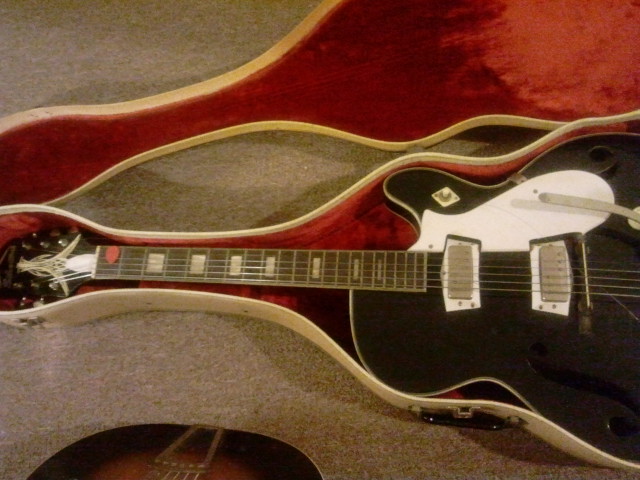
The Epiphone Wilshire was a bit of a rare model until the its reissue this past year (made in China- sadface). It has always had a small Mahogany body and neck but had two different editions. The first was introduced in 1959 with a 3+3 headstock and P-90 pickups. The second version appeared in mid-1962 that had a funky "batwing"style headstock and two mini humbuckers. Mine is the second version with the silky smooth mini hums.
I absolutely love these guitars. They have the coolest 60s styling with quality ingredients to boot. The mini humbuckers are very versatile and can take you from Guns and Roses to Neo-classical jazz in a real hurry. The neck joins at the very last fret so the player has full advantage of the fretboard. Unfortunately the "Vibrola" was a source of frustration for most players so the trem arm is usually taken off and lost.
This is my second mid 60s Epiphone Wilshire. My first one had seen some playing time and the finish showed it. It was still original (but was missing the trem arm of course). I eventually sold it but still had my love of Wilshires. When I saw the ad for this one I couldn't believe it. The seller was the original owner and the finish looked like it had just rolled off the assembly line. I asked him when and by whom it was refinished. He said that it hadn't been refinished. Well, I have heard that before. I always take that kind of thing with a grain of salt.
When I showed up to look at the guitar I still couldn't believe it hadn't been refinished. We met outside of a Waffle House so I couldn't really take the pickguard off to check. It looked "right" so I went ahead and bought it. I took the pickguard off but the wires kind of stuck. I looked closely to see what was going on. Yes, the wires were stuck in the lacquer. I carefully peeled them away to find that I was the first one to ever take the PG off. This was clearly the original finish. There was even a little bit of router dust in the electronics cavity. That was a cool moment but I totally regretted it after! I knew I had to take the pg off to verify the originality of the finish and electronics but I wish that it had still "never been taken off." Oh well.
There is no checking on this guitar. NONE. It looks like it was made recently. This thing is as real as it gets. There are a couple of nicks around the guitar (about 3). That is all. The original owner was not keen on the original set of tuners so he had them changed to mini Schallers. He also lost the tremolo arm. Other than that, this is the way it came from Kalamazoo. One thing that is weird is that the gold Epiphone silk screen logo was done once, painted over, and done again slightly more centered. Must have been a new guy at the silk screen booth that day.
The seller said he went into the shop in '67 to buy a Gibson SG. He saw this one up on the wall and bought it instead. Good call. I don't think he played it very much because it has hardly any fret wear or wear on the back of the neck. It is an absolute joy to play I hope you get a chance to play one of these oddities sometime too.
I took this guitar to the Nashville guitar show and another dealer was interested in it. He took it over to an amplifier and played it for a while. When he came back he told me that the pickups were wire out of phase! That was news to me but I wouldn't have noticed it because I stick mainly to the neck pickup. I took it out this morning and messed around with it and found that he was probably right. One other thing I found interesting is that the bridge pup is rotated 180 degrees from where it "should" be. I asked the original owner why he swapped it and he said that he didn't. That is the way that it came from the factory.
Peter Green's 1959 Gibson Les Paul was made this same way in that his pickups are wired out of phase as well. Apparently it is more common than originally thought but most people probably didn't notice it. Maybe they just played on the neck pickup too...
I picked up this Harmony Bobkat a couple of days ago. I didn't feel like writing tonight but I wanted to get the word out about these so I made a quick video about it. Check it out, comment, disagree, like it, share it.... participate.
I just wanted to show that while I could be playing much more expensive and technically "better" guitars, instead I am playing this one. You don't have to pay 3 grand to get a solid vintage guitar. Price does not translate into quality, playability or tone. The price of a vintage guitar is only the result of supply and demand. Most of the time the demand for a guitar and its overall tone/quality go hand in hand but there are always exceptions. I believe this is one of them.
When I was back in school I was lucky enough to find a guy with an early 50s J-45 and a mid to late 30s L-00. I knew the J-45 was for me so I quickly sold off the L-00. Mistake. The thing had been played and played and needed a neck reset but it felt so good. Sounded even better. When I got word of this one for sale I was ecstatic.
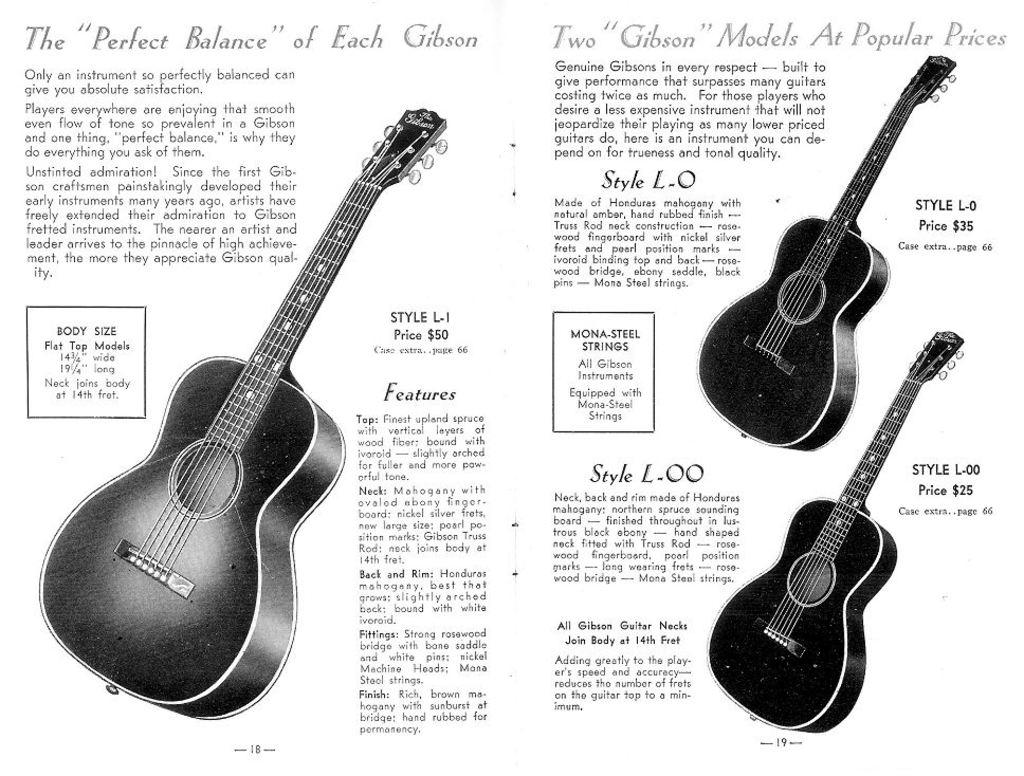
The L-00's first catalogue appearance was in 1932 but supposedly they had been making them since 1929. They were Gibson's budget model flat-top guitar. They were lightly built cheapies that were made out of whatever they had around at the time. Consequently, the features tend to be a bit sporadic. They all feature Adirondack Spruce tops and Mahogany back and sides. The L-00 began as a 12 fret guitar but changed to 14 in '33.
This advertisement is kind of interesting. The 00 is on the lower left and just beside the body of the guitar is a short paragraph about how they are using 14 fret necks for more comfort and fret board access. You may have noticed that none of the guitars picture have 14 fret necks. This is typical of Gibson I guess, sigh.
This particular L-00 has a bit of a story attached to it. Before I had seen it in person I saw a few pictures from the owner. One showed the back of the headstock. I could see a little impression in the lacquer that I recognized as a "Made In USA" stamp. This was the marker that Gibson used on all export instruments that went outside of the US. But I found this guitar in Tennessee?? I was a bit perplexed because almost all of the instruments that come my way are "finds" as in not from a dealer so how did this guy get this thing anyway?
After talking with the owner for a bit I got the story on how he came to own the guitar. His uncle was housing a drifter for a while but the drifter had no way to pay him. All he had was this guitar so he used it as payment. The uncle had no use for the instrument so when his nephew showed an interest in music he gave it away. That was a long time ago. The owner had made his way to the states by way of Canada- the missing link in the story.
This guitar was easy to date as far as vintage Gibsons go. I saw from the pictures that it had a small burst so I knew it was early to mid 30s. The Factory Order Number was easy to read: 876 which appeared in the ledgers in 1933.
The neck on this old guitar has a wide 1 3/4" nut width with a fairly defined "V" shape that I find very comfortable. I'm not sure why this shape has fallen out of vogue. Fingerstyle blues just feels "right." The neck is straight, frets properly dressed and the action is very comfortable. I was looking for signs of a neck reset but I couldn't find them. I believe that this is the original neck angle. The saddle is kind of low but not as low as I would expect. There is still a bit of room to come down if needed.
Some of the guitars from this era have some kind of ugly wood. They have been seen with three piece tops and backs and off center seams. Supposedly this was the reason for the small burst: most of the wood was not very aesthetically pleasing so the burst served to cover it up. For some reason this guitar was spared of ugly wood. The top is a nice 2 piece book matched Spruce and the back is a solid piece of close-to-quarter sawn Mahogany. The sides are both quarter sawn. I say close to quarter because it looks like this piece was very close to the center of the tree. Here is what I mean by quarter sawn vs. flat sawn:
Quarter sawn wood has a higher strength to weight ratio but wastes more wood. It is considered higher quality because of its features and scarcity.
The Tone Report: Open, woody, Americana. If you closed your eyes and just listened to it you might mistake it for a much larger guitar. However, it is much different than a dreadnought. It is more nuanced and sweet. They are fantastic for fingerpicking. The notes are clearly defined as well as balanced. If you plan on strumming away your Nickleback chords then you may want to stay away from a 00. The boom and sparkle probably won't be enough for you (as well as other obvious problems with that situation).
Dating this Gibson L-00 was relatively easy with the features and Factory Order Number. The number is 867 which according to Spann's Guide to Gibson means 1933. The other features were the small burst which was done in the early 30s and the solid kerfing on the interior of the guitar. This is the lining that provides a solid glueing surface for the rims to the top and back. This was mostly used in the late 20s and very early 30s. There are some exceptions such as my friend's '32 L-00 that has standard cut pieces of Mahogany. Here is a shot of the solid kerfing:
And the FON:
I'm really excited to have another L-00. I really love fingerstyle blues and this is the guitar to have for that (except for maybe an L-1?). I thought I liked the larger burst of my last one better but I've changed my mind. The small burst is unique and the reasons behind it are representative of the times in which it was built.
I got an email from a reader with a couple of pictures attached. Needless to say, I was pumped.
It's a Silvertone 1446! It is always a great day when you find an old guitar in a closet, under the bed, wherever it was left years ago and forgotten. This one seems to be original except for the decal pinstripes on the headstock. I think they are cool but I would probably still attempt to remove them if I felt comfortable with it. It even has the original case and seems to be in good shape.
Damian sent these in to my email (tvguit@gmail.com) and said he had an amp with it too. Way to go Damian! Maybe he will send in some pictures of the amp?? Are you reading this Damian? Don't leave us hangin' man!
I saw an old amp on Craigslist in Tuscaloosa the other day. It was a Silvertone 1472 sporting about 10 watts or so and a 12" speaker. I was heading to Tuscaloosa on business that day so I figured I would inquire about it. Unfortunately I was about 10 minutes too late.
The seller was very nice and asked what else I was interested in. I told him I like anything old and made in America. He said he had an old Kay flat top that had a body made by Gibson. I thought to myself, "I've heard that before."
The body was not made by Gibson but that didn't matter to me. This is a mid 1950s Kay (Harmony) Jumbo (actual model? I dunno. Maybe just Kraftsman). It was made in Chicago and features a solid Spruce top, solid one piece flame Maple back and veneer sides. It has 17" wide hips (a regular dreadnought is 16") and has ladder bracing. It is original save for the Guild bridge added sometime long ago. It even came with the original Kluson tuners!
I was drawn to this guitar for three reasons: the size, appointments and the FLAME MAPLE BACK! This is an absolutely beautiful slab of maple. They didn't even cut it in half and book match it. It is just one solid piece of sexy Maple.
She came to me in pretty good shape except that the neck was falling out and there was no nut or saddle. I was very excited to have another neck reset project. My last one didn't go so well but I learned a lot from it. You can read all you want about it but there is not substitute for just doing it. I highly suggest it if you are so inclined and have a suitable subject (ie not Gibson).
This is a dovetail joint. It requires skilled craftsmanship to make and fit the neck to the guitar at just the right angle. It takes a lot more time and human attention than a bolt on neck. Dovetail joints are not easily made by machines. They are a sign of old world craftsmanship. Do you own a Taylor? Your guitar probably does not have one of these.
I was really excited to see no gaps when I was done! These are crappy cell phone shots. I forgot to take real pictures. I didn't want any good evidence in case it went bad.
The wife was kind enough to let me turn the apartment into a repair shop. It was a mess and still kind of is. This is a shot of me cutting the me bone nut. It was my first full nut made from scratch. I was happy with the result since it was my first try. I will definitely do some things differently next time.
This is an interesting guitar because it has a 26" scale length. That is the distance from the saddle (the white piece on the bridge) to the nut (the white piece at the top of the neck). The standard scale length for a Gibson is 24 3/4" and the standard Martin scale is 25 1/2". This is significant in both the way it plays and sounds. A longer scale means that the strings must be tighter in order to sound the note. This usually makes for a louder and more difficult to play instrument (on average). The tighter the string is the more difficult it is to push the string down to the fret. Needless to say, this thing is a hoss to play and sounds great!
Another interesting feature (or lack thereof) is the absence of a truss rod. Maybe it was just an attempt to save money. They accounted for this by making the neck a monster. It is by far the biggest neck I have ever seen. It really gives it that 40s and 50s feel. The neck is straight as an arrow so I guess they called Time's bluff.
I really like the peghead overlay on this one. They used a celluloid overlay and carved and painted the detail and logo with white and gold paint. I was talking with a friend about this guitar and he made a good point about how the peghead is very underused and plain on most guitars. I agreed and thought that this was one of the most beautiful headstocks I have ever seen.
A friend of mine called me the other day and said that he had just traded his old drum set for this 1957 Fender Vibrolux:
Needless to say, I was very excited. Back in school I bought a small collection of vintage Fenders including a 1960 Champ, 1959 Princeton, 1960 Deluxe and a 1964 Vibro Champ. Pete would come over and we would blues out with me on his Strat (and the Deluxe!) and him on the harmonica with the Champ. TONE gentlemen, tone.
Until one time I was holding the strat and he had the harp mic in his hand and he tried to show me where on the fretboard I should play. As he touched the strings and froze I instantly remembered how both of these awesome old tweed amps had the original 2 prong power chord. "Dude, are you alright?' I said not sure if he was confused or shocked (literally). One second later he jumped back out of his frozen state and reminded himself never to do that again. Please change the 2 prongs to 3. Vintage isn't cool if you are dead.
But I did remember how wonderful that deluxe sounded after the tubes warmed up. Here is a shot of my old tweed Deluxe (gone now along with the others):
That is candle wax from an old recording gig it played
Full shot of Pete's Vibrolux:
Tweed doesn't always wear very well after this long. I actually really dig the distressed look of an old amp. The speaker has been replaced but it still sounded so sweet with my '64 Fender Duo-sonic. We played a little jam of Hendrix's "The Wind Cries Mary" with him playing lead on the DS and me playing rhythm on his 1951 Gibson J-50. Loads of tone.
The Vibrolux's were rated at 10 watts and had a 12" Jensen speaker. They had 3 instrument inputs and a Depth, Speed, Tone and Volume knob. They have a variable bias tremolo that really sounds sweet. This particular unit had a GE 5y3 rectifier tube, a Sylvania 6v6 and an Emerson 6v6 power tubes and unknown 12Ax7 preamp tubes.
Luckily, the original 2 prong chord had been traded for a 3 prong recently. You can see from this picture that the tweed Fender cabinets were finger jointed pine boxes. This is a really cool way to join two pieces of wood and allowed for great transfer of tonal energy throughout the entire box. Plus, it looks awesome. Fortunately this one shows off it's finger joints!
Here is a video of Chris playing through a brand new Echoplex to the Vibrolux and a new Victoria (tweed bassman).